
When you start shopping for a weed mat, GSM is the one spec on the label that determines whether your garden project succeeds or you’re back at the store in six months buying a replacement. Too light, and it tears under mulch and foot traffic. Too heavy, and you’re overpaying for a raised bed that didn’t need that much muscle. Whether you’re a weekend gardener trying to keep weeds out of your beds or a landscaping business sourcing pallets of weed control fabric for your next commercial job, picking the wrong GSM is an expensive mistake that’s easy to avoid once you know what to look for. Let’s break down how GSM works, what thickness fits your project, and how to buy smart the first time.
What Is GSM, and How Does It Decide Your Weed Mat Choice
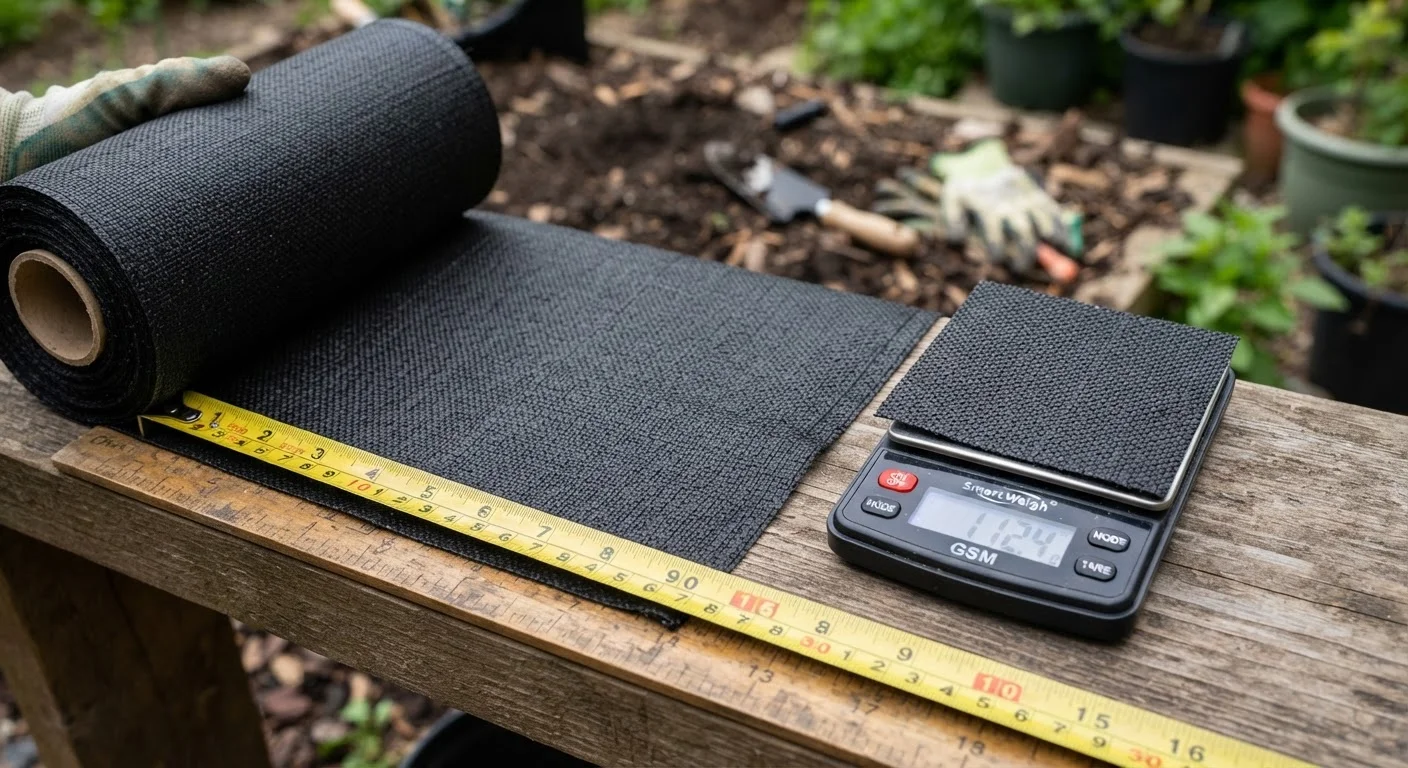
GSM stands for grams per square meter, a simple weight measurement that tells you how much fabric you get per square meter of coverage. Manufacturers test it by cutting a 10cm x 10cm sample (0.01 m²), weighing it, and multiplying by 100. That’s your GSM figure. The formula looks like this:
GSM = Sample Weight (g) ÷ Sample Area (m²)
Simple math, but it’s the single number that separates a flimsy mulch mat from a durable PP weed control fabric built to last years.
The Direct Relationship Between GSM and Fabric Performance
Higher GSM generally means denser, heavier, more tear-resistant material. That’s the logic behind most weed barrier selection guides, and it’s true to a point. But “heavier is always better” is a myth worth busting. Denser fabric often means less water permeability, higher cost, and stiffer handling during installation. A good garden weed barrier balances weed suppression, drainage, ease of laying, longevity, and your actual budget.
Practical GSM Ranges by Use Case
For 70–90 GSM, you get lightweight, short-term coverage that’s budget-friendly. It works for temporary weed suppression or casual garden beds. 90–130 GSM is the sweet spot for typical home gardens and standard landscaping projects, giving you solid durability without overspending. 130–200+ GSM is heavy-duty, built for driveways, high-traffic zones, or harsh conditions. It’s tougher and more tear-resistant, but pricier and less flexible.
Why GSM and Thickness Aren’t the Same Thing
GSM and thickness usually trend together, but you can’t convert one directly into the other. Fiber type, whether woven or non-woven, and how tightly the material is compressed all affect actual thickness. Judge a weed mat roll by GSM, tear strength, and permeability, not by thickness alone.
Pick the GSM that matches your project, not the highest number on the shelf.
Choosing GSM by Use Case: The Complete Grading Guide from 60 to 180+
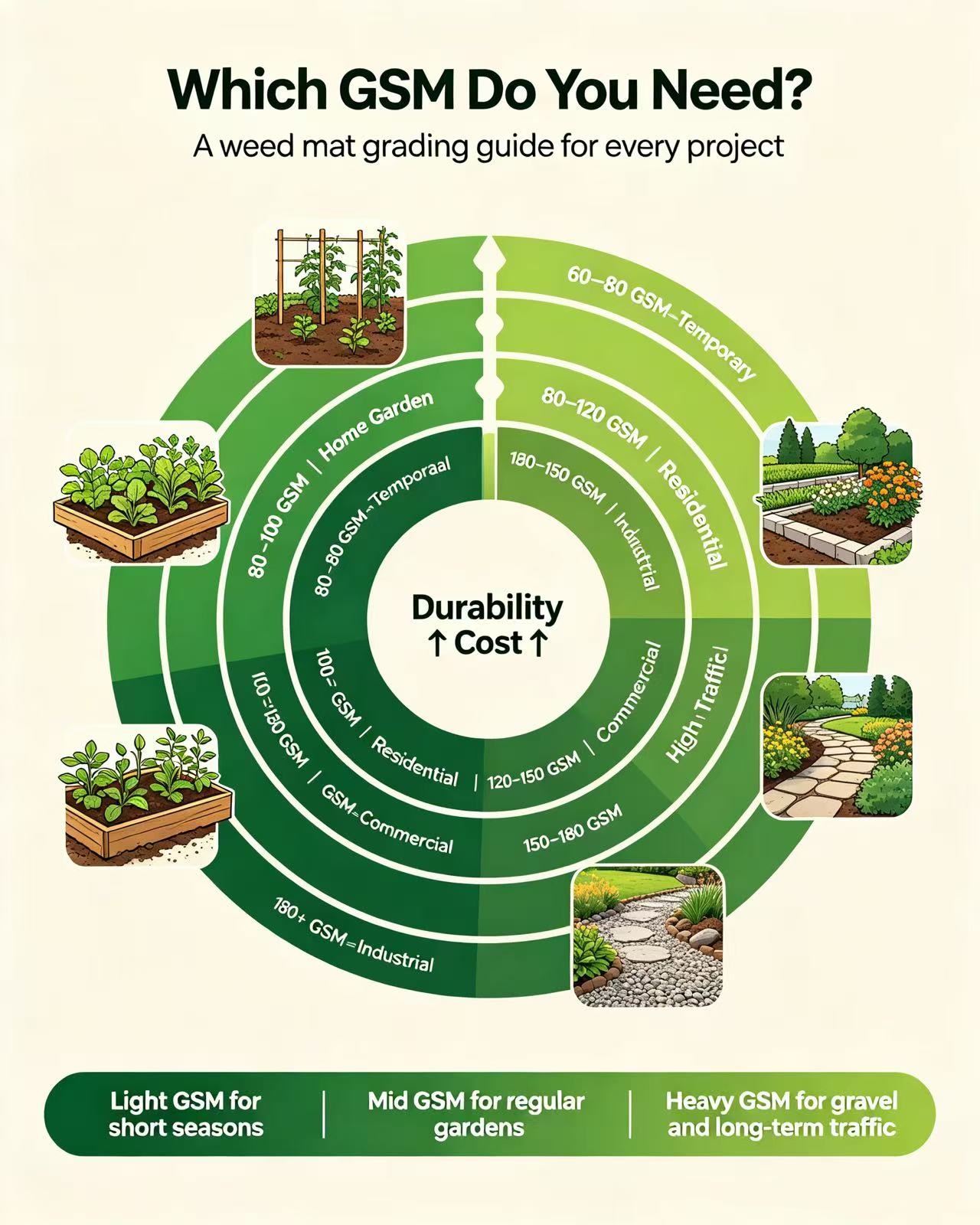
Six GSM brackets cover nearly every weed mat use case you’ll run into, from a one-season nursery cover to a driveway that needs to survive a decade of foot traffic. Each tier below explains the lifespan and cost logic.
60–80 GSM: Temporary and Disposable Projects
This is your lightest, softest weed suppressant fabric. Think one-off seedbed covers or short-cycle weed blocking where you don’t need the mat to outlive the season. Expect 1 season to 6 months of real-world use, less if it’s baking under direct sun or getting walked on. Lowest price point, lowest lifespan. Fine for temporary jobs, a poor choice for anything you’re planning to leave down.
80–100 GSM: Entry-Level Home Garden Use
A step up for basic home garden weed control, light mulch coverage, or nursery paths that don’t see heavy traffic. You’re looking at 6 to 12 months of service without major mechanical wear. Better than the bottom tier, but still an entry-level pick, good for low-risk, “let’s try this out” scenarios.
100–120 GSM: The Home Gardener’s Sweet Spot
This is where most home gardens land. Standard weed barrier under mulch, edges of landscaping beds, or the base layer beneath raised beds all work well here. Lifespan runs 1 to 2 years, and the cost-to-durability ratio is arguably the best balance you’ll find for residential use.
120–150 GSM: The Commercial Landscaping Workhorse
This bracket is the go-to for weed mat for raised beds, commercial landscape base layers, and gravel path substrates that see some foot traffic or compression. Expect 2 to 3 years, longer if there’s mulch, bark, or gravel on top reducing UV exposure. Most commercial landscaping jobs default here because the cost-per-year math works out best.
150–180 GSM: Built for Gravel and High-Traffic Zones
If you’re installing weed mat under gravel paths, commercial walkways, or areas with frequent maintenance access, this tier holds up. Lifespan sits at 3 to 5 years. Upfront cost is higher, but fewer callbacks and re-installs make it the smarter buy for gravel-heavy landscaping.
180+ GSM: Industrial-Grade, Heavy-Load Protection
Reserved for high-abrasion, heavy-load, or long-term gravel/traffic zones where failure isn’t an option. Plan on 5+ years, sometimes longer with protected installation or premium composite materials. It has the highest initial investment and the lowest maintenance frequency. Choose it when downtime costs more than the mat.
Quick Selection Rules
|
Project Type |
Recommended GSM |
|---|---|
|
One-season temporary cover |
60–80 GSM |
|
Regular home gardening |
100–120 GSM |
|
Raised beds / landscape base |
120–150 GSM |
|
Under gravel paths |
150–180 GSM |
|
Heavy-load / industrial |
180+ GSM |
For B2B Buyers: Match GSM to Your RFQ
When sourcing pallets, use these specs for your purchase order:
-
“weed mat for raised beds” — quote 120–150 GSM
-
“weed mat under gravel” — quote 150–180 GSM or higher
-
“temporary nursery cover” — quote 60–80 GSM
-
“commercial landscape weed barrier” — quote 120–180 GSM
Matching the tier to actual wear conditions minimizes total cost over the mat’s working life.
5 Purchasing Metrics to Check Beyond GSM
GSM tells you the weight, but it won’t save you from a mat that turns brittle in a hot climate or clogs your soil’s airflow within a year. Smart buyers check five additional specs before placing an order, especially for large-scale or B2B purchases.
1. UV Resistance (Priority in High-Sun Regions)
A high-UV formula extends outdoor lifespan by 40–50% over standard weed control fabric—5–8 years in full-sun conditions. When suppliers share accelerated weathering data: 7–14 days of testing typically simulates 1–2 years outdoors, while UVA-340 testing at 0.69–1.38 W/m² over 1–3 months captures 5–10 years of real exposure. In intense UV or high-altitude climates, ask suppliers to run tests for 1–2 months at 1.38 W/m². That gives you more realistic results.
2. Air and Water Permeability
Don’t settle for vague “weed-blocking” claims. Ask for the actual permeability rate. A good benchmark: permeability decay should stay ≤15% after long-term service—not just at initial installation.
3. Fabric Width
Wider rolls mean fewer seams, less overlap waste, and faster installation on large sites. Compare coverage area per roll, not just unit price.
4. Roll Length
Longer rolls reduce mid-job roll changes. Confirm net roll length and weight per roll—theoretical lengths sometimes fail during transport or unrolling.
5. Minimum GSM for Traffic Load
Foot traffic and vehicle loads need higher GSM and stronger tear resistance than standard mulch mat coverage. When sourcing, always separate “decorative weed suppressant fabric” from “load-bearing” specs.
What GSM weed mat should I buy for heavy-duty vs light-duty jobs
A 150GSM+ heavy mat and a 60–100GSM light mat solve different problems. Heavy-duty picks belong on commercial job sites, high-frequency vehicle paths, and any surface that’s soft, wet, or unstable underfoot. Light-duty mats do fine when foot traffic, seasonal timing, or a tight budget are your main concerns.
When Heavy-Duty Wins
-
Commercial construction access routes with trucks, cranes, or tracked excavators crossing the same ground repeatedly
-
Gravel driveways, soft subgrade, or muddy sites where the surface sinks or ruts easily
-
Long-term outdoor installations exposed to sun for years, where a UV-resistant weed mat and thicker fabric survive degradation better
-
Multi-season reuse projects that get rolled up, moved, and relaid repeatedly
-
Point-load zones under crane outriggers, pump truck legs, or lift equipment
-
Oil, gas, and drilling platform paths with heavy, frequent equipment traffic
When Light-Duty Is Enough
-
Seasonal vegetable gardens that go down for one growing cycle and come back up
-
Nursery beds with light foot traffic or hand carts, nothing mechanical
-
Short-term weed suppression where you just need bare soil covered temporarily
-
Low-traffic garden paths with occasional walking, no heavy gear
-
Short-cycle projects like temporary events or edge protection at a job site
Three Mistakes That Trip Up Buyers
People underspec constantly. They measure square footage but forget point loads from equipment legs. They assume traffic stays light, then a delivery truck rolls through unannounced. Or they treat a “temporary” install as disposable, not realizing it’ll get reused for three more seasons. Match GSM to actual load and lifespan, not just today’s plan.
B2B Bulk Purchasing Guide: How to Request Quotes and Inspect Goods from Suppliers
Most bulk buyers lose money before the order ever ships—not because of bad product, but because of a sloppy RFQ. Get every detail on the table upfront: specs, quantity, lead time, payment terms, MOQ, quote validity, sample policy, packaging, and inspection standards. Send that same request to 3–5 suppliers at once. That’s how you compare apples to apples on a weed mat roll instead of guessing.
Market Wholesale Specs to Quote Against
Four GSM tiers dominate agricultural and landscaping RFQs:
-
90 GSM — lightweight, cost-driven, short-cycle coverage
-
100 GSM — the standard middle ground for general farming and landscape use
-
110 GSM — built for higher tensile strength and longer service life
-
120 GSM — heavier-duty, suited to demanding, longer-term jobs
Always ask suppliers to quote by GSM, weight tolerance, width, roll length, and UV rating. Skip this, and “same spec” quotes from different vendors won’t match.
Six Parameters to Lock Down Before You Buy
-
Custom width — production range, min/max, slitting availability
-
Custom roll length — per-project sizing and how it affects container loading
-
UV stabilizer ratio — get the exact percentage in writing, not just “UV resistant”
-
PP grade — virgin vs. recycled material affects strength and lifespan
-
Packaging and MOQ — per-roll packaging, carton/pallet counts, tiered pricing
-
Sample policy — typical initial batches run 5–10 pieces; confirm who pays freight and whether sample cost gets refunded on bulk orders
Inspection Checklist Before Container Loading
Seal a reference sample first—this becomes your acceptance benchmark. Then check bulk shipments against it for dimensional accuracy, material composition, physical performance, weathering resistance, and packaging integrity. Compare quantity, appearance, and labeling against the sealed sample, not the original quote sheet.
Manufacturer-direct suppliers like gsunplas.com typically hand over tiered pricing, MOQ, and lead times without middlemen slowing things down. Worth asking for directly in your first inquiry.
Quick Pick: Your GSM Selection Cheat Sheet by Budget and Scenario
Skip the guesswork. If you just want a number to hand your supplier, here’s the cheat sheet.
The All-Rounder: 100–110 GSM Woven PP Weed Mat
This tier covers orchards, nurseries, greenhouse floors, decorative gravel, and general walkways—every standard gardening or agricultural job. 90–100 g/m² is the baseline for modern farmland and pathway weed control; 110–120 GSM works for higher-wear or longer-service conditions. Woven PP is chemically stable, durable, and has three times the tensile strength of standard PE fabric. Get it in black, UV-stabilized, breathable, rolls with width 1–4 meters depending on the job.
Heavy Load / Driveway Pick: 120–150 GSM
120 GSM handles decorative gravel plus occasional vehicle or foot traffic—an upgrade from the standard tier. 130–150 GSM+ is built for driveways, vehicle turning zones, compacted bases, and sharp gravel. The extra weight gives you real durability gains in higher friction environments. If it’s just foot traffic and decorative stone, 120 GSM usually works. If wheels and sharp aggregate are involved long-term, go straight to 150 GSM.
Commercial / Long-Term Projects: 150 GSM+
For commercial landscaping, long-term orchards, engineering-grade greening, and parking areas, lifecycle cost matters more than sticker price. Woven PP lasts 3–5 years outdoors. With proper UV stabilization and installation, heavier fabric can suppress soil and root-driven weed pressure by roughly 90–95% in the early years. Higher upfront cost trades for less labor, fewer herbicides, and fewer reinstalls.
Budget Quick-Pick
|
Budget |
GSM |
Best For |
|---|---|---|
|
Low / seasonal |
70–90 GSM |
Short-term veggie beds, temporary jobs |
|
Mid / general |
100–110 GSM |
Home gardens, orchards, greenhouses |
|
High / heavy-load |
120–150 GSM |
Driveways, parking, commercial landscapes |
|
Long-term / engineering |
150 GSM+ |
High-traffic, no-reinstall projects |
Order Template You Can Copy
-
Material: Woven PP standard; PE+PP composite for stronger sun resistance
-
Color: Black preferred for better light-blocking
-
Performance: Permeable, breathable, UV-resistant, tear- and puncture-resistant
-
Installation tip: Compact the base first. Bump to 120 GSM+ under gravel, 150 GSM for vehicle zones.
Frequently Asked Questions
Buyers ask the same handful of questions before finalizing an order. Here are straight answers.
How long does a weed mat last?
It depends on GSM. 60–80 GSM runs 6–12 months. 80–100 GSM lasts 1–2 years. 100–120 GSM holds up 2–4 years. 120–150 GSM survives 3–5 years. 150–180 GSM stretches to 4–8 years, and 180+ GSM goes beyond 8 years.
Is 110 GSM enough?
Yes, for most jobs. It sits mid-range in the 100–120 GSM bracket, ideal for home gardens, garden paths, and general landscaping. Expect 2–4 years of service.
Is higher GSM always better?
No. Heavier fabric means more durability, but also more weight and cost. Match GSM to the job: 60–80 GSM for light beds, 80–120 GSM for garden paths, 120 GSM+ for gravel roads or commercial sites.
Is weed mat biodegradable?
Standard PP weed control fabric is built for long-term durability, lasting 1–8+ years. Biodegradable wool mats are a different product category, for mulching and moisture retention. Don’t compare the two using the same lifespan metric.
Conclusion
Match the GSM of the weed mat to your actual project. A light 60-80gsm sheet might be perfect for a weekend flower bed, but if you’re outfitting commercial landscaping jobs or raised beds that need to last for years, you’ll want something heavier and UV-stabilized that won’t tear apart by season two.
Whether you’re a hobbyist keeping dandelions out of your tomatoes, or a distributor sourcing weed mat rolls by the pallet, check specs (GSM, material type, UV rating) before price. That’s where the money gets saved long-term.
Our team at gsunplas.com manufactures custom weed control fabric in bulk—woven or non-woven, any GSM you need. Reach out for a quote, and let’s find the right fit for your ground.


0 Comments