
Choosing the wrong weed barrier fabric on a commercial job shows up six months later as roots pushing through gravel, water pooling where it shouldn’t, or a maintenance crew back on-site sooner than anyone budgeted for. If you’re sourcing materials for a parking lot, solar farm, or large-scale landscaping project, you’ve probably already narrowed things down to woven and non-woven options. But you need to know which one holds up under your specific conditions.
This landscape fabric comparison breaks down how each geotextile weed barrier performs under real commercial stress—permeability, tensile strength, longevity—so you can match the right fabric to the right project before you commit to a bulk order.
What Is Woven Weed Barrier Fabric: Structure & Commercial Performance
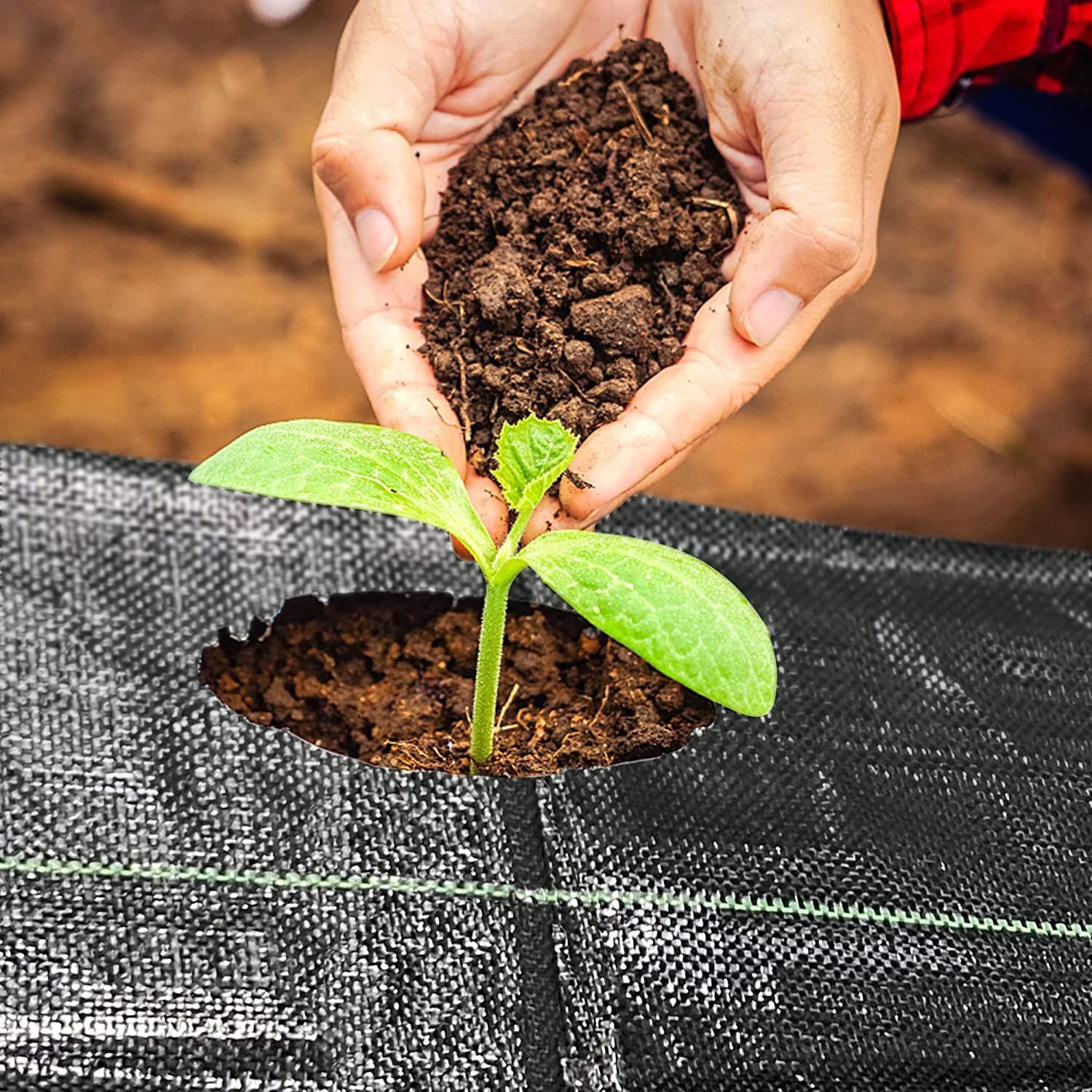
It is a grid of polypropylene tape strands, woven in both directions. That structure—a woven geotextile—is built for separation, reinforcement, and puncture resistance under heavy commercial loads. You’ll find it under gravel driveways, in hardscape next to parking lots, and as a base layer beneath pavers.
Strength Numbers That Matter
The weave drives the tensile strength. A 5 oz/sq yd (170 g/㎡) product tests at 850N longitudinal and 950N transverse. At 3.2 oz/sq yd (108 g/㎡), you get roughly 620N/750N. Higher weight and denser weave means better resistance to stone pressure, punctures, and tearing—important for gravel beds and zones where vehicles roll over the fabric repeatedly.
UV Stability and Real-World Lifespan
Commercial-grade woven landscape fabric carries UV stabilization to slow polypropylene brittleness from sunlight. Manufacturers rate this at about 5 years outdoors. But context matters: exposed fabric holds up for 6–12 months before UV degradation becomes a problem. Bury it under gravel or mulch and that lifespan jumps to 3–7+ years. Heavier contractor-grade fabric can push past 10 years with proper maintenance.
Thickness Options for Different Jobs
-
3.2 oz/sq yd (108 g/㎡): Light commercial use—flower beds, general landscaping, low-traffic paths
-
3.5 oz/sq yd (119 g/㎡): Mid-tier commercial, common for drain cloth applications
-
5 oz/sq yd (170 g/㎡): Heavy-duty standard for gravel driveways, rock beds, paver bases
-
5–8 oz/sq yd: Contractor-grade range for high-traffic, vehicle-load zones
Four Specs to Check Before You Order
-
Weight class—3.2, 3.5, or 5 oz benchmarks
-
Tensile strength—look for warp/weft data, 850N+ for 5 oz
-
UV certification—explicit stabilization claims with 5-year outdoor ratings
-
Application fit—3.2–3.5 oz for landscaping, 5 oz+ for driveways and hardscaping
What Is Non-Woven Weed Barrier Fabric: Structure & Drainage Function

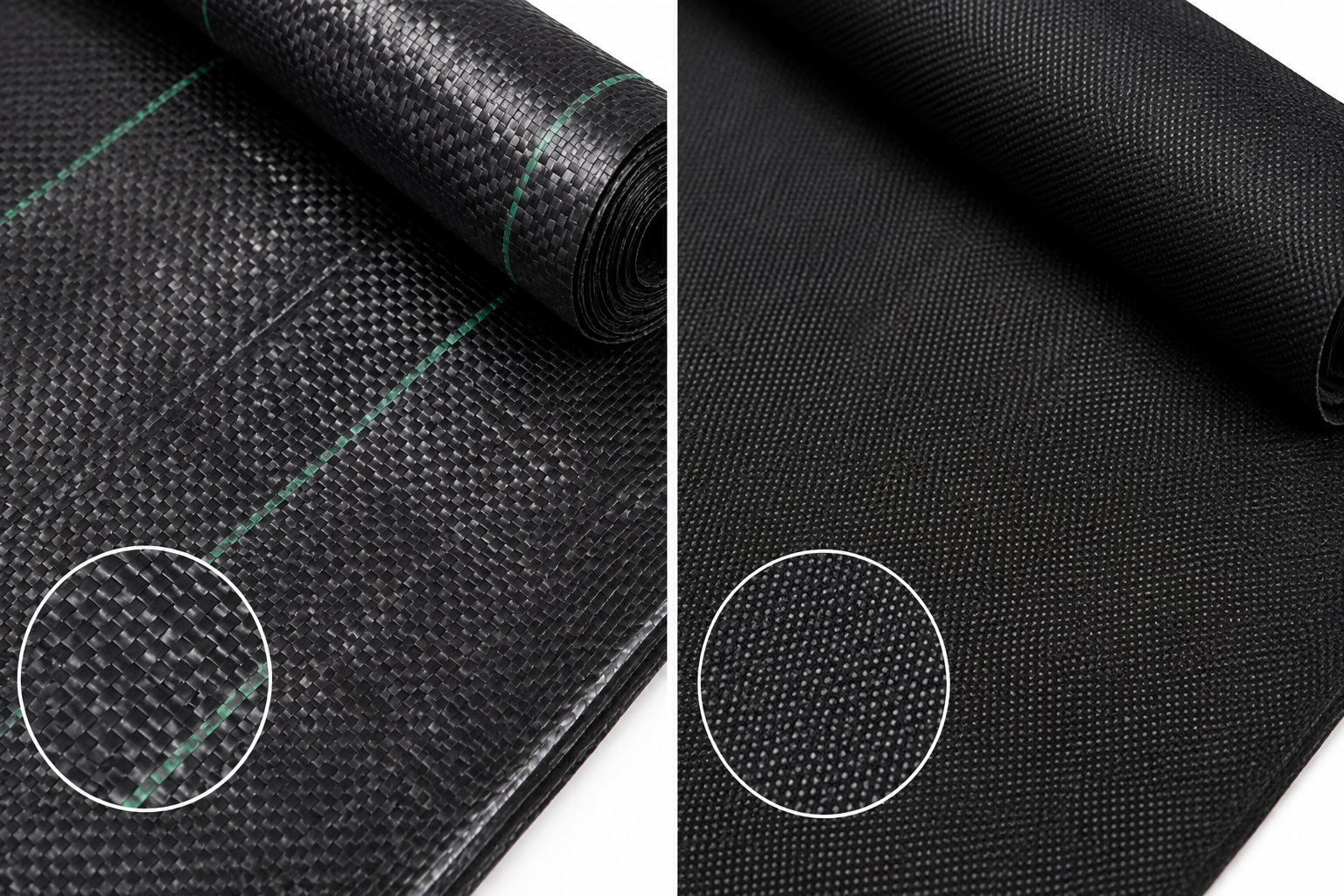
Flip the woven fabric over and you get a different animal. Non-woven weed barrier fabric skips the grid pattern altogether. Manufacturers needle-punch polypropylene or polyester fibers into a random, three-dimensional pore structure. That punching process creates interconnected voids throughout the material. That’s why this fabric drains so differently from woven geotextiles.
Why Drainage Performance Wins Here
Random fiber layout with punched pores lets water, air, and nutrients move through while sediment gets filtered out. Independent testing gives permittivity around 1.2–2.2 s⁻¹ under ASTM D4491, with discharge capacity between 3,500 and 5,800 L/m²/min at a 50mm constant head. Filtration openings sit between 0.07 and 0.212mm AOS. That’s tight enough to block fine soil but open enough to keep water moving.
That’s why contractors wrap this erosion control fabric around French drains. It lets water into the drain while keeping soil and sediment out, so clogs are less likely over time. You’ll also see it specified for retaining-wall backfill, subdrain wraps, and geomembrane protection. Anywhere the job needs separation, filtration, and drainage in one layer.
Weight and Strength Specs by Application
-
Heavy-duty commercial grade: 8 oz/yd², 350N tensile strength, 440N load capacity. Built for French drains and driveway/gravel underlayment.
-
Light-duty garden rolls: typically sold at 100 ft × 4 ft, positioned for basic weed control rather than engineered drainage.
-
Industrial drainage range: 90–300 gsm, available in widths up to 8m for large commercial runs.
-
Needle-punched performance envelope: 0.3–1.5 s⁻¹ permittivity, 8–30 kN/m wide-width tensile strength, 500–3000+ N CBR puncture resistance.
Landscape Fabric Durability: The Buried vs. Exposed Split
UV-stabilized non-woven geotextile can last 20–50 years in harsh conditions when properly buried. Exposed to UV, expect roughly 70–90% strength retention after just 500 hours. That’s a steep drop, so burial is non-negotiable for long-term projects. The biggest life-shorteners are UV exposure, physical puncture, and installation stress. If drainage or filtration is the priority, go with needle-punched non-woven. If you’re just suppressing weeds under mulch, lighter fabric usually does the job.
Woven Vs Non-Woven: Core Performance Comparison Table
Numbers settle arguments faster than opinions do. Here’s how woven and non-woven weed suppression fabric stack up when you run them through the same ASTM benchmarks contractors actually reference in spec sheets.
|
Metric |
Woven |
Non-Woven |
Standard Used |
|---|---|---|---|
|
Grab Tensile Strength |
401–911 N (across 200R–420R grades) |
267–900+ N (light-duty to heavy-duty) |
ASTM D4632 |
|
Trapezoidal Tear Strength |
180–350 N |
111–360+ N |
ASTM D4533 |
|
Permittivity |
Lower than non-woven at comparable weights |
1.63 sec⁻¹, 0.3 cm/s, 150 g/min/ft² (6 oz fabric) |
ASTM D4491 |
|
UV Retained Strength (500h) |
~70% retained |
50% minimum spec baseline; 70–90% on premium products |
ASTM D4355 |
Woven fabric wins on tensile-to-weight efficiency, which makes it the default for hardscaping and vehicle-load zones. Non-woven pulls ahead where filtration matters more than raw strength, like permeable landscape fabric. Heavy-duty non-woven specs exist for grab tensile above 900N and permeability over 70 L/m²/s, but they are the exception, not the baseline.
For spec sheets: strength priority points to woven; drainage priority points to non-woven. UV exposure means verifying D4355 data regardless of which you choose.
Best Commercial Use Cases: Matching Fabric Type To Project Type
Spec sheets don’t tell you where to use the fabric on a real job site. This section closes that gap. Once you know the strength numbers and permittivity rates, you just need to decide which project gets woven, which gets non-woven, and where the two overlap.
When Woven Fabric Is The Right Call
Woven geotextile earns its place anywhere the fabric needs to hold weight and keep materials separated. Gravel driveways, paver installations, walkways, and light vehicle areas. The job here is load distribution and separation under aggregate or hardscape.
Installation follows a standard pattern. You lay woven fabric on prepared subgrade, overlap the seams, then add your base aggregate on top. That sequence keeps fines from pumping up into the base layer over time, which causes potholing and surface instability years down the road.
For mulch beds, nursery rows, and farm-style planting areas, woven fabric also handles weed suppression for hardscaping-adjacent zones where surface traffic resistance matters more than filtration. Commercial-grade hardscape projects like gravel lots, paver patios, and foot-traffic zones spec around 5 oz woven fabric as the baseline weight.
When Non-Woven Fabric Is The Right Call
Non-woven geotextile takes over the moment water management becomes the priority. French drains, trench drains, and blanket drainage systems all depend on high water transmission paired with fine-particle filtration. Miss that filtration function and the drainage system fails as soil fines migrate into the rock voids, clogging the pipe.
Commercial drainage projects spec non-woven fabric at 4–6 oz/yd², with permeability rated between 0.1–1.0 cm/sec for French-drain applications. That’s the range that lets water pass while keeping soil out of the stone bed.
Non-woven also handles soil separation beneath driveways, roads, and gravel bases, same separation job as woven but with drainage built in.
Combining Both For Larger Commercial Builds
Most large-scale jobs don’t pick one fabric exclusively. Paver and driveway projects often layer non-woven on the subgrade for filtration, add compacted aggregate, then use woven fabric in adjacent gravel or mulch zones for surface weed control. Retaining-wall projects follow the same logic, with non-woven behind the structure for drainage and woven above in traffic zones for load support.
Cost & ROI Analysis For Bulk Commercial Purchasing
Sticker price tells you almost nothing about what a fabric actually costs over a 15-year project window. That’s the trap most procurement teams fall into when they compare woven and non-woven quotes side by side.
What You’ll Pay Upfront
Woven commercial-grade fabric runs $0.12–0.29/sq ft for standard 5–6 oz rolls. A 4′ x 300′ roll at 5 oz lands around $140–260; step up to 6 oz and you’re looking at $190–340. Heavy 8 oz woven climbs to $0.25–0.55/sq ft.
Non-woven drainage fabric costs less out of the gate—$0.05–0.15/sq ft, with a 4′ x 100–300′ roll priced at $60–180. Bulk import pricing at 2,000 sq m order sizes shows a wider spread, $0.13–1.14/sq m, depending on spec.
Lifespan Changes the Math
Woven fabric buried under gravel or mineral cover typically lasts 15–20 years. Non-woven professional-grade material runs 5–10 years before it starts breaking down; lightweight consumer versions can fail even faster. That gap matters more than the initial price tag once you factor in replacement labor, disposal, and site disruption.
Running the ROI Numbers
For municipal mineral cover, gravel beds, nursery aisles, and parking-adjacent landscape zones, woven wins. One avoided replacement over 15–20 years usually outweighs the upfront premium, especially when access and restoration costs are high. Non-woven makes more sense for short-horizon installs or drainage layers where the site gets redesigned within 5–10 years anyway.
Quoting Bulk Orders
Ask suppliers for pricing on a per-m² and per-roll basis across three spec tiers: light non-woven, standard woven, heavy woven. Then compare installed cost—material, freight, labor, staples, and future replacement labor—not just the purchase price. For mid-term projects, run a 10-year total cost comparison. For long-life commercial sites, extend that to 15–20 years.
How To Choose: Decision Framework For Commercial Projects
Every commercial site has one dominant problem to solve first. Figure out whether that problem is weed suppression, drainage, or load-bearing, and the fabric choice mostly picks itself.
Match Fabric To Your Core Site Problem
-
Weed suppression is the priority: Go heavier and denser. 4–5 oz/yd² covers flower beds and walkways. Step up to 6 oz for gravel zones with regular foot traffic. Driveways, parking pads, and base stabilization take vehicle loads, so they need 8 oz or higher.
-
Drainage is the priority: Non-woven wins here. French drains, subsurface drainage layers, and low-lying areas prone to pooling all depend on its filtration and flow rate.
-
Load-bearing plus drainage together: Woven and non-woven combine into a layered system, especially on parking lots, solar farm ground cover, and any hardscape that needs to carry weight and shed water at once.
Quick Selection Checklist
-
Parking lots and gravel driveways: 8 oz woven minimum. Check tensile strength (850N/950N range), thickness (around 29.5 mil), CBR puncture resistance (ASTM D6241, ~332 lb), and water flow rate (ASTM D4491, ~10.5 gal/min/sf).
-
Solar farms: Heavy woven fabric handles load and separation across the array field. Layer non-woven underneath in wetter zones, inverter pads, and cable trenches where drainage matters more than surface strength.
Installation Notes For Combination Systems
Grade and clear sharp debris before laying anything—punctures start at the subgrade level. Overlap seams generously; narrow overlaps split under gravel and vehicle loads. Set fabric on compacted base, not loose topsoil, and plan drainage outlets before installation. Non-woven filters water, but it still needs somewhere to go.
Questions About Woven Vs Non-Woven Weed Barrier
Procurement teams ask the same handful of questions before they sign off on a bulk order. Here’s what matters.
Is non-woven better for weeds?
No. Woven’s tight weave blocks sunlight and roots on beds, paths, and mulch zones. Non-woven works better for drainage and filtration, not weed suppression.
Which lasts longer for surface weed control?
Woven wins again. UV-stabilized woven fabric runs 3–7+ years exposed to sun and traffic. Non-woven in the same conditions lasts 1–3 years before fibers break down.
Which drains better?
Non-woven, no contest. If water needs to pass through soil layers, non-woven is the answer.
Which is stronger under load?
Woven ranks higher in tensile and tear strength, so it handles gravel paths and low-traffic zones better.
Quick rule for sourcing decisions:
For weed suppression on top, choose woven. For water moving through soil, choose non-woven.
When vetting suppliers, request ISO 9001, SGS, or CE documentation, plus GSM specs and UV-aging data before committing to a container-load order.
Conclusion
There’s no universal winner here—only the right material for the job. For heavy foot traffic, gravel installations, or long-term hardscaping, woven fabric’s tensile strength and durability will save you costly re-installs down the road. For mulched beds, sloped terrain, or erosion-prone sites where drainage and flexibility matter more, non-woven geotextile is the smarter bet.
Match the thickness, permeability, and lifespan to your project’s actual demands and budget. That protects your ROI and your reputation with clients.
Grab our comparison table, run it against your next project spec, and reach out to a manufacturer who can advise on bulk sourcing before you break ground—not after weeds do.


0 Comments