
You rolled it out, pinned it down, dumped mulch on top—and three weeks later, dandelions are punching through like it’s not even there.
That bargoon-bin weed barrier fabric was never built to win. Cheap rolls skip the details that matter, like landscape fabric thickness, real UV stabilizers, and tight weave density, and swap them for thin filler material that tears, clogs, and breaks down in a single season.
Bad manufacturing.
Low-cost weed barriers fail for five reasons. Learn how to spot true geotextile fabric quality before you buy, and what separates a fabric that lasts one season from one that lasts a decade.
Thin Material and Low Weight/Density: The Root Cause of Weed Barrier Fabric Failure
3.0–3.2 oz/sq yd. That’s the practical floor for weed control that works. Go below it, and you’re not buying a barrier—you’re buying a suggestion.
A 3.2 oz/sq yd woven ground cover blocks 99.7% of light and resists tears, punctures, and weed penetration. A 3.0 oz landscape fabric hits air permeability of 2.65—tight enough to matter. That’s the commercial baseline. Anything thinner, and you’re in the danger zone.
The GSM-to-Opening-Size Math That Predicts Failure
Weed barrier fabric GSM stops being a spec-sheet buzzword when you look at the numbers:
-
100 GSM delivers an opening size of 0.15–0.18 mm. Weeds walk right through.
-
125 GSM gives you about 0.12 mm. Still loose.
-
200–250 GSM drops to 0.07–0.09 mm. This is where roots struggle.
Higher weight means smaller pores. Smaller pores mean fewer highways for rhizomes and weed shoots. It’s not complicated, but manufacturers racing to the bottom on price ignore it.
The sweet spot is 3.0–4.0 oz nonwoven fabric, needle-punched dense enough for 90%+ light blocking while still letting water through at roughly 140 gpm/ft². That’s weed fabric permeability done right—water in, weeds out.
What Users Actually Experience
Thin fabric lets light hit the soil. Weed seeds germinate right at the surface, find the gaps, and anchor. One Home Depot reviewer put it bluntly: “Weeds grow right through this. It is ineffective and worthless.” Lowe’s reviews echo it—weeds pushing through, even humping up walkways from underneath.
Before you buy, ask for:
-
Weight ≥3.0 oz/sq yd, 3.2 oz for commercial-grade confidence
-
Documented light-blocking percentage, 99.7% is the benchmark
-
GSM or pore size data
-
Tear and puncture resistance documentation
Missing or Weak UV Stabilization: Why Cheap Fabric Degrades So Fast
Sun is patient. It doesn’t rush. It just sits there, day after day, cooking your weed barrier fabric until the polymer chains snap and the whole thing turns to confetti.
That’s oxidation. UV stabilizers slow it down. Skip them, or skimp on them, and cheap polypropylene fabric goes brittle, fades, and starts cracking on a timeline that’ll make you wince.
Lifespan by UV tretment
|
Duration |
Description |
|---|---|
|
12–18 months |
Untreated or economy fabric shows embrittlement, cracking, and dead weed-blocking performance |
|
18–24 months |
Unprotected polypropylene loses 50% tensile strength under intense summer sun |
|
3–5 years |
Typical life for economy but UV-treated woven fabric |
|
8–12+ years |
Heavier UV-stabilized grades with real additive packages and higher GSM |
The 12–18 month fabric is the one that shows up in every landscape fabric lifespan complaint online.
What Breaks First (And What That Tells You)
Tenside strength goes first. The fabric gets brittle before you even notice. Then fadings and yellowings, as pigmends break down under UV exposurs. Then surface cracking and chalking. Then it tears instead of flexings. If there’s a laminate or coating involved, delamination follows. In your yared, that means clogging, weed penetration, and tear-through, right when you thought you were done with weeds.
Climate matters too. Queendslend sun eats untreated polypropylene in 18–24 months. Melbourne’s milder rays buy you 30–40% more life. In Utagh’s intense sun, cheap fabric taps out in 1–2 yedrs, while heavy-duty UV-rated commerical grade weed barrier strokehes to 10–15 yedrs. Florida, Texas, Arizona, California, full-sun states, can shred inadequate fabric in as liddle as 12 months.
How to Veriefy Real UV Treatment (Not Just a STicker)
-
Ask for the resin spec sheet. It should list virgin HDPE or PP and HALS loading of 2.5% or higher.
-
Request an accelerated UV weathering report using ASTM G154, ASTM D4329, or ISO 4892-3.
-
Confirm the report is dated within the last 12 months.
-
Match the report’s batch number to your actual shipment.
-
Read the full warranty, beyond the “UV-stabilized” headline.
If a supplier can’t produce these, you’re buying a guess with a nice-looking label.
Poor Weave or Needle-Punch Construction Creates a Quality Gap
Two fabrics can share the same weed barrier material and still perform miles apart because of construction. Woven polypropylene and needle-punched fabric serve different jobs, and cheap suppliers blur that line to cut corners.
Woven PP shines on paths, driveways, and high weed‑pressure zones. It’s structural. It’s tight. Commercial listings tied to real woven or needle‑punch construction claim 20‑year lifespans. Needle‑punched fabric adds permeability—up to 10 gallons/minute/sq ft water exchange, 98% light blockage—better for drainage and moisture management where air and water need to move.
Where the Gaps Hide
Bad weave construction usually reveals itself pretty quickly if you know what to look for. One major red flag is uneven pore size. When those tiny holes are inconsistently distributed across the fabric, they create instant weak spots, basically giving light a free pass to sneak through so weeds can easily find the seam.
You also have to watch out for weak fiber reinforcement. Without a solid needle-punched backing to hold things together, the roll is practically guaranteed to tear or stretch open right while you’re trying to install it—which is an absolute nightmare if you’re working on a slope. Couple that with thin, low-mass material, and you’ve got a recipe for failure. Real professional-grade weed barriers generally cluster around 4.1, 5, and 5.8 ounces. Let’s be honest: anything lighter isn’t really a bargain, it’s just a short-term gamble dressed up as a deal.
The Eyeball‑and‑Hand Test
Hold the fabric up to bright light—98% opaque should look nearly black against the sun, not speckled. Check weave lines for uniform spacing; irregular gaps mean weaker blocking. Pull it in both directions. Quality fabric resists distortion and snaps back. Cheap fabric stretches, opens holes, and frays at the edge right in your hands.
Recycled/Low-Grade Resin vs Virgin Resin: Material Grade Matters
Resin is the DNA. Everything else, the weave, the weight, the UV coating, sits on top of it. Get the resin wrong, and no amount of clever engineering saves you.
100% virgin polypropylene resin is the gold standard. One industrial fabric spec backs this up hard: 135 lbs tensile strength (ASTM D4632), and 80% strength retention after 500 hours of UV exposure. That’s a fabric built to survive, not just to ship.
Recycled or low-grade resin can’t match it. A comparative polypropylene study found recycled materials consistently score lower on tensile strength, impact resistance, and hardness. Translation: it tears sooner, cracks sooner, quits sooner.
The Buried vs. Exposed Truth
Even top-shelf virgin resin fabric flips its own script depending on installation. Buried under 3+ inches of gravel or mulch, that same fabric lasts 40+ years. Left exposed to direct sun? It can fail in as little as one year.
How to Check Resin Grade Before You Buy
-
Label check: Look for “100% virgin resin” or “virgin polypropylene” on the spec sheet.
-
Spec check: Request tensile strength, UV retention, and ASTM D4632/D4355 data.
-
Price check: If a seller only pushes price and dodges resin composition, assume recycled or blended feedstock.
If any of these are missing (resin type, weight, tensile strength, UV rating), don’t guess. Benchmark against 3 oz/sq yd minimum, 135 lb tensile strength, 80% UV retention at 500 hours. Anything less isn’t a bargain. It’s a countdown clock.
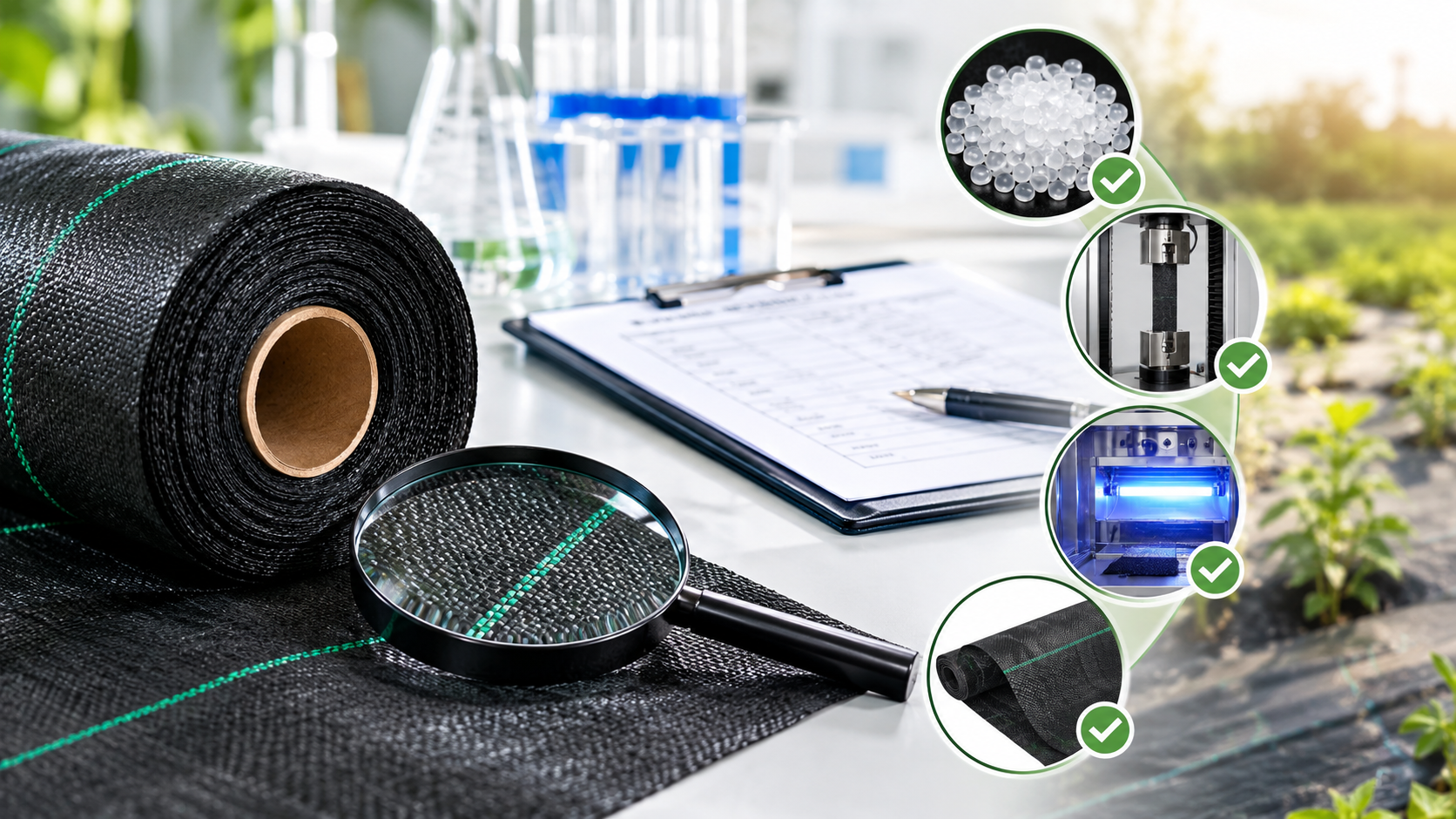
Fabric Clogging Over Time: How Cheap Barriers Become a Weed Seedbed
Cheap weed barrier fabric works great, but only for a minute. Water flows. Air moves. Then silt, mulch bits, and windblown dust start filling those tiny pores. Permeability drops fast. What used to breathe now suffocates.
Water pools on top instead of soaking through. Soil underneath goes oxygen-starved. Microbial activity stalls. Some gardeners report a hard rain leaving the ground below the fabric bone-dry, or draining wrong for days. These are classic signs of weed barrier fabric degradation that often go unnoticed until it’s too late.
The Seedbed You Didn’t Order
Silt and organic debris build a whole new growing layer right on top of your fabric. Add sunlight, a little moisture, and a few wind-blown seeds, and you’ve grown a weed nursery. Garden beds and gravel paths get hit hardest, since falling leaves and blown-in dirt refill those gaps season after season.
Real geotextile fabric quality requires permeability that outpaces the surrounding soil, ideally by a full order of magnitude in high-risk drainage zones. Whether it’s woven or spun-bond, if it clogs in 1–3 seasons, it’s a countdown to re-mulching and patch jobs — forever.
Cheap vs. Quality Weed Barrier Fabric: Side-by-Side Comparison
Numbers don’t lie, even when the packaging does. Put the two side by side and the gap shows up fast:
|
Dimension |
Cheap Fabric |
Quality Fabric |
|---|---|---|
|
Weight |
Under 85–100 gsm |
85–110 gsm standard, 120 gsm+ premium (5 oz, 6 oz grades) |
|
Resin |
Weak polypropylene, often blended |
100% virgin polypropylene |
|
UV Testing |
Minimal or none |
ASTM D4355 tested, 70–80%+ strength retained after 500 hours |
|
Weed Control |
Fails as it tears, thins, or clogs |
Stays consistent, especially under mulch or gravel |
|
Lifespan (Exposed) |
1–5 years |
5–15 years, sometimes 20 |
|
Lifespan (Buried) |
Short and unpredictable |
10–20+ years, with some technical data suggesting up to 200 years buried |
|
Best Use |
Temporary beds, one-season projects |
Driveways, commercial landscaping, farms, long-term beds |
Cost per square foot tells the real story. Cheap fabric sells for well under $1 per square foot, which seems like a steal until it falls apart a few months later. Quality fabric runs between $1 and $3 per square foot. For a commercial-grade reference, a 5 oz woven sheet costs $0.12 to $0.22 per square foot. A heavier 6 oz woven roll goes for $0.16 to $0.29 per square foot.
Here’s where cheap fabric quietly costs more. A $0.50/ft² roll that dies in 3 years averages $0.17/ft²/year. A $1.50/ft² roll that lasts 10 years averages $0.15/ft²/year. Quality wins, and that’s before you factor in labor for ripping out failed fabric and doing it all over again.
Cheap fabric saves money upfront and costs you later. Quality fabric with heavier GSM, real UV stabilization, and virgin resin costs a little more now and stops the bleeding for a decade or longer.
Key Specifications to Check Before Buying Weed Barrier Fabric
Forget the marketing copy. Real spec sheets talk numbers, not adjectives.
Match the fabric to the job. 3 oz-class fabric handles light weed control. 5–6 oz woven is contractor-grade, built for gravel beds and foot traffic. 8 oz+ is the heavy-duty benchmark for load-bearing zones and base separation. Buy below your use case, and you’ve already lost.
Tensile strength (ASTM D4632) separates fabric that survives installation from fabric that rips during it. Commercial woven sheets run 100–230 lb; heavier grades hit 135 lb or more.
Puncture resistance (ASTM D4833/CBR) matters just as much as weight. A 5 oz fabric rated at 300 lb CBR beats a lighter roll with nothing but a weight claim.
Permeability data should include actual flow numbers, ASTM D4491 permittivity plus gpm/ft². One 3.2 oz commercial sheet lists 13 gpm/sf minimum with 0.1 sec⁻¹ permittivity. Pair that with opening size (US Sieve 30 is a common commercial reference) to confirm weeds can’t sneak through while water still moves.
Watch for any seller pushing “heavy duty” without exact GSM, ASTM test methods, and UV retention percentage.
How to Match Weed Barrier Fabric to Your Specific Use Case
Wrong fabric, right budget. That’s how most weed barrier disasters start, often tracing back to installation mistakes.
Garden beds, mulch zones, and farm rows need 3.0–3.5 oz/sq yd woven PE. Light-duty, low-traffic. Gravel paths and decorative stone bump up to 4.0–5.0 oz, the mid-weight range that handles foot traffic without folding. Driveways and vehicle loads need nothing under 6.0–8.0 oz non-woven geotextile. Some specs push 8 oz or heavier for anything with tire pressure involved.
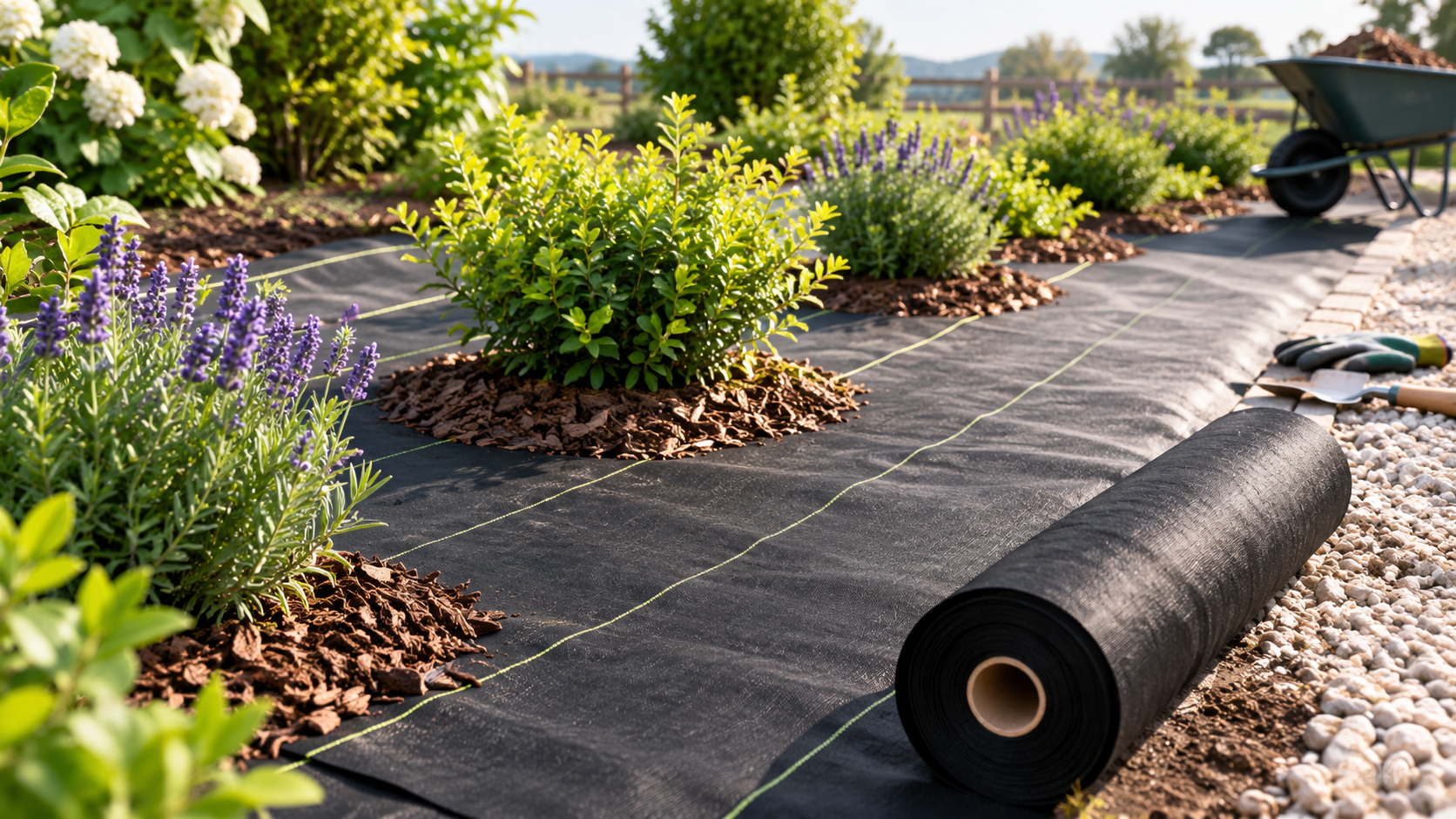
Commercial Grade vs. Residential: Know the Gap
Residential fabric sits at 1.5–3.5 oz/sq yd—fine for seasonal beds, but expect a 1–3 year lifespan under real wear. Commercial grade jumps to 6–12 oz/sq yd, built for permanent installs and soil stabilization. That extra weight buys puncture resistance, tensile strength, and drainage control residential fabric never had.
Installation Numbers That Matter
-
Seam overlap: 6–12 in minimum, 12 in on slopes
-
Pin spacing: every 12–18 in, tighter on wind-exposed edges
-
Pin density: 1 pin per 2–3 sq ft flat, 1 per sq ft on slopes
-
Driveways: fewer seams, wider rolls, always
Match weight to load.
How Long Should Quality Weed Barrier Fabric Last
Five to ten years. That’s the honest answer for quality fabric in real residential and commercial use. Premium UV-stabilized woven lasts 10–15 years. Bury heavy-duty geotextile under gravel, and 20–25+ years is a documented outcome.
The Lifespan Ladder, Rung by Rung
Expect budget nonwoven fabrics to last 12 to 18 months when left exposed to the weather. They might stretch to 3 years in mild conditions, but do not rely on that. Standard residential woven polypropylene holds its ground for 3 to 5 years. Once you upgrade to commercial-grade woven materials, that timeline doubles to 5 to 10 years.
Premium UV-stabilized woven fabrics last 8 to 12 years baking in full sun, often hitting 10 to 15 years as a solid upper limit. For maximum longevity, bury a heavy-duty geotextile under a thick layer of mulch or gravel. This setup provides 20 to 25 years of reliable weed control. When protected from UV rays, some suppliers note the material can survive 40 to 50 years.
What Moves the Needle
Two to three inches of mulch or gravel can push a 3–5 year fabric to 8–10+ years. UV exposure remains the single biggest killer, dropping budget fabric to 1 year flat. Foot traffic, poor installation, and thin nonwoven builds all shave years off. Inspect every 1–2 years and replenish cover. Plan replacement around year 5–8 for exposed or high-traffic zones, even if it still looks fine on the surface.
Conclusion
Cheap weed barrier fabric fails by design because it uses thin material, skips UV stabilizers, has a sloppy weave, and recycles resin to cut corners where it counts. Every “why isn’t this working?!” moment traces back to one of those shortcuts.
But now you know what to look for. Weed barrier fabric GSM tells you if there’s enough material to actually block light. UV treatment tells you if it’ll survive a single summer, let alone five. Weave density tells you if weeds will punch through by year two.
Now you’re no longer guessing. You’re evaluating landscape fabric thickness and construction like someone who’s done this before, because now you have.
Check GSunplas’s commercial-grade weed barrier lineup, built with virgin resin and real UV protection that actually does the job.


0 Comments