
One damaged pallet of weed barrier fabric can cost a landscaping company more than the material itself — think re-shipping fees, delayed installs, and a client who now questions your judgment. That’s the real risk hiding behind a low per-square-meter quote.
If you’re sourcing landscape fabric in bulk, the difference between woven PP fabric and non-woven ground cover fabric isn’t academic — it directly affects tear resistance, water permeability, and how many years that fabric survives under mulch or gravel. Add GSM weight standards, UV resistance ratings, and MOQ negotiations into the mix, and price comparisons quickly become guesswork without the right framework.
This guide breaks down exactly what separates a reliable supplier from a costly mistake — covering material specs, cost drivers, and the qualification checklist procurement teams actually use before placing a bulk order.
Weed Barrier Fabric Types: Woven vs Non-Woven
Not all weed barrier fabric is built for the same job. Confusing woven PP fabric with non-woven weed fabric, or treating a garden ground cover roll like a driveway-grade material, is one of the fastest ways to end up with a warehouse full of returns.
Woven PP Fabric (PP Woven Fabric)
This is the polypropylene weed mat you want under gravel paths, driveways, and hardscaping. It’s a tight PP woven structure, typically black, sold in rolls with 3.0–5.8 oz/yd² (roughly 100–196 g/m²). Retail samples show tensile strength around 620N lengthwise and 750N crosswise, with heavy-duty variants rated at 135 lbs. Common widths: 3ft, 4ft, 6ft, 6.5ft; lengths 100–330ft. Pricing spans from $34.70 (4ft × 100ft, 5.8oz) up to $129.34 (3ft × 250ft, 5oz).
Non-Woven Weed Fabric
Built for water permeability. Needle-punched or thermally bonded, this fabric has pore connectivity for drainage, soil separation, and geotextile filtration. GSM typically sits at 70–90, sometimes near 100 g/m², with UV stabilization included. If your project needs constant water flow-through, use non-woven.
Ground Cover / Mulch Film
Nurseries and row-crop growers rely on this: 3oz, 5oz, and 6oz weights dominate, often with pre-punched holes matching plant spacing. Pricing runs from $9.99 (3ft × 50ft heavy-duty) to $101.13 (4ft × 300ft, 3oz).
Matching Material to Application
|
Application |
Best Fit |
Key Spec to Verify |
|---|---|---|
|
Gravel/driveway |
Woven PP |
Tensile strength, roll width |
|
Drainage/filtration |
Non-woven |
GSM, pore structure |
|
Nursery/row crops |
Ground cover film |
Hole spacing, coverage cost |
Buyer mistakes worth avoiding: assuming higher GSM always means better performance (irrelevant for drainage-focused non-woven), or deploying punched ground cover under gravel where friction causes premature tearing. Mismatched fabric selection is the leading cause of re-installs procurement teams report.
How to Choose GSM Weight, Water Permeability, and UV Resistance Ratings
Three numbers on a spec sheet determine whether your fabric order lasts a season or a decade. Pick the wrong one and you overpay for strength you don’t need, or buy too little protection your project cannot survive without.
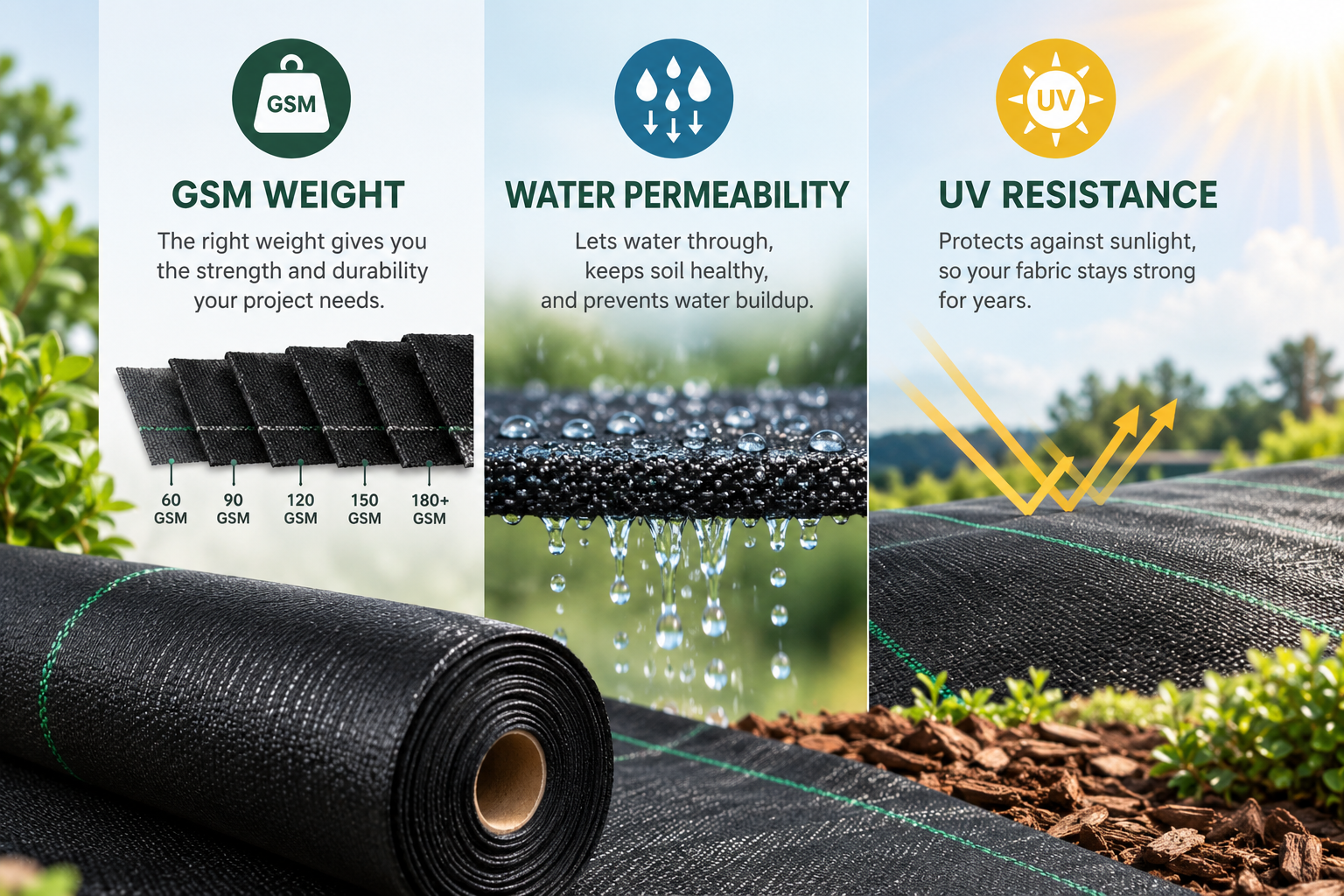
GSM Weight Standard: Matching Weight to Load
-
10–50 gsm: Light-duty coverage, short-cycle use. Tensile strength runs 5–30 kN/m on non-woven variants. Fine for separation, not for anything under foot traffic or vehicle load.
-
136–250 g/m²: The landscape and garden workhorse. Target tensile strength hits ≥8 kN/m, water permeability ≥80%. Built to handle paving bases, flower beds, and walkways without excess cost.
-
250 gsm+: Commercial-grade, engineered for road bases, retaining walls, parking areas. Public spec sheets show tensile strength climbing to 50–200 kN/m. This tier is about load-bearing, not filtration.
Water Permeability: Read the Soil
Published permeability ranges span 0.01–0.1 cm/s, with engineering-grade products reaching 0.001 cm/s. Higher permeability drains faster, but you have to check filtration and soil retention together, or you lose fines through the fabric.
-
Wet, fine-particle soil: choose the upper end of the range to prevent pooling.
-
Sandy/gravel base: mid-to-high permeability avoids water backing up.
-
Silt/clay-heavy ground: don’t chase the highest number. Over-permeable fabric lets fines migrate through and kills the filter layer.
Look for ASTM D4491 test data on the spec sheet. Landscape-grade products often list ≥80% water permeability or flow rates around 110 L/m²·s for fast-drain applications.
UV Resistance: Match Exposure Time
The standard acceptance threshold is ≥70% strength retained after 500 hours. Premium products hit 90% at 500 hours. Some specs treat 50% retention as the floor. Check which baseline your supplier is quoting.
-
75% retained: fine for general outdoor use, but shorten exposure time in high-sun climates.
-
90% retained: built for long install cycles, extended transport, or extended outdoor storage before burial.
One engineering-grade product shows 70% retained strength after 500h UV and is rated for 15–20 years buried underground with no light exposure. Compare that to unprotected polypropylene near the equator, which can lose up to 95% of its strength within 3 months of direct sun exposure. UV retention percentage alone does not predict field life. Burial, mulch cover, and shade all extend it. Rule of thumb: exposed rooftop or staging sites need ≥70%/500h minimum. High-sun, long-exposure projects need ≥90%/500h.
Width and Roll Length: The Logistics Multiplier
-
Common widths: 0.5–6 m, with engineering rolls at 3.0m, 4.6m, 5.33m, 6.0m.
-
Common lengths: 100–4,000 m per roll. Retail and project rolls run 100–200m. Bulk supply can exceed 500m.
Wider rolls mean fewer overlaps, faster install, less labor, and less seam waste. Longer rolls reduce roll changes on large sites, but roll weight, handling, and last-mile delivery costs climb with it. Narrow, short rolls suit retail and small landscaping jobs where manual handling flexibility matters more than install speed.
Quick Selection Formula
|
Use Case |
Recommended Spec |
|---|---|
|
Light landscape work |
136–250 gsm + mid-high permeability + UV ≥70%/500h |
|
Fine, clog-prone soil |
Higher GSM + moderate permeability |
|
Heavy road base/commercial |
250 gsm+ + high tensile strength + UV ≥70–90%/500h |
|
Large-area installs |
Width ≥3–6m, roll length ≥100–200m |
Ask any supplier to produce ASTM D4491 permeability data and 500-hour UV test reports before they quote a bulk order. If they cannot, that is your first red flag. Not the price.
Breaking Down Bulk Purchasing Thresholds: MOQ, Supply Methods, and Room to Negotiate Lead Times
Suppliers set MOQ three different ways, and each tier changes how much room you have to negotiate.
Weight-based MOQ (1,000–2,000kg) fits standard categories like dyed rolls or raw pellets. Cross the 1-ton mark consistently, and suppliers usually open up on unit price, fixed production slots, and custom packaging.
Area-based MOQ (5,000 sqm) applies to fixed-spec fabric, coated cloth, and film products. Below 5,000 sqm, expect higher per-unit cost and more waste; above it, you’re in mass-production pricing.
Container-based MOQ (20GP) is where most factories set their “negotiable” floor. A 20-foot container holds roughly 28 CBM of stackable cargo, but the real break-even point comes earlier.
LCL vs FCL: The CBM Math
-
Under 10 CBM: LCL wins.
-
10–15 CBM: Get quotes on both — this is the gray zone.
-
15–30 CBM: FCL usually beats LCL on price and lead-time stability.
Formula: FCL unit cost = total 20GP price ÷ CBM volume. If LCL’s per-CBM rate exceeds that number, switch to FCL.
Stock vs Made-to-Order
Stock moves fast but limits customization. MTO/OEM/ODM gives you color, width, and punching pattern options, at the cost of higher MOQ and longer lead time. Higher MOQ brings the unit price down; more customization pushes lead time up.
Lead Time Levers
Dyeing, punching, and custom packaging each add days to a week. Push suppliers for a segmented timeline covering raw material, production, packaging, and a shipping buffer, and negotiate delay penalties or on-time bonuses when placing bulk orders.
Price Breakdown: The Cost Logic Behind a $0.05-$0.4/sqm Price Gap
The eightfold price gap comes from four cost layers stacked on top of each other: base material, processing, packaging/logistics, and volume discounting. Once you separate these layers, a quote becomes a negotiation tool.
Material and GSM drive the floor price. GSM is calculated as weight(g) × 10,000 ÷ (length × width in cm), and it tells you how much raw material sits in every square meter. For a benchmark from comparable woven fabrics, moving from 120 GSM to 200 GSM pushes price up 40%–100%+. Every 25% jump in GSM adds roughly 20%–25% to unit cost, according to a rough industry rule. Width also matters because wider rolls dilute per-unit processing waste, often lowering effective landed cost per sqm.
Processing is where custom orders get expensive. Printing, private labeling, punching, lamination, and embossing are billed as stacked add-ons, each adding its own cost. Printed-goods pricing has shown 10%–12% swings industry-wide; small-batch single-side printing can run around $0.31/piece.
Packaging scales inversely with order size: bare roll, stretch-wrap, and carton packaging each add cost, and small orders (1,000 vs 50,000 units) absorb setup waste disproportionately. Upgrading packaging also raises volumetric weight, which increases per-sqm freight cost.
To unlock tiered pricing, split your order into trial, first-batch, and annual repurchase volumes. Give suppliers your target GSM, width, packaging tier, and lead time upfront. Vague RFQs rarely get real discounts.
Pre-Purchase Checklist: 12 Confirmation Points From Scenario Fit to Receiving Details
Most bulk orders fail because nobody double-checked the spec sheet. Price is rarely the issue. Run through this confirmation list before wiring a deposit.
1. Match GSM to scene. Nursery/flower beds: 60–100 GSM, 6–24 month lifespan. Walkways: 100–120 GSM. Gravel/driveway: 120–180 GSM for pressure and foot traffic. Farmland/vegetable rows: 80–120 GSM, balancing permeability and durability.
2. Get GSM in writing. Common tiers run 70/80/100/120/140/150/180/220 GSM. Ask for tolerance range, test method, and actual per-roll weight — not just a catalog number.
3. Lock width and length. Standard widths: 1m, 2m, 3m, 4m, 5m (custom ranges span 0.3m–4.3m). Confirm finished net width, roll length, seaming method, edge trim.
4. Quantify permeability. Confirm the spec sheet states a “water permeability/permeable” structure. 12×12 weave density typically means more strength and controlled drainage; 8×8 skews toward economy and higher flow-through. Note irrigation and drip-line compatibility in writing, too.
5. Get UV rating documented. Look for claims like “UV resistant 3,000 hours” or “up to 8 years direct sunlight.” Confirm UV additive ratio, test hours, warranty scope.
6–7. Customization details. Color (black/green/dual-tone), punching (hole size, spacing, pattern), private label markings (brand, batch, net weight), packaging (single/double roll, carton dimensions, moisture protection).
8. MOQ sequencing. Run a trial order first, then lock bulk color, GSM, and width.
9. Logistics — three-way confirmation. Port, warehouse address, contact, unloading window, and Incoterms (FCA/FOB/CIF/DDP) in the PI.
10–12. Receiving checks. Verify appearance, dimensions, GSM per roll, color consistency, and packaging condition against your final confirmation sheet.
Supplier Qualification Assessment Four-Dimension Model: Factory Capability, Document Credentials, Delivery Record, and After-Sales Support
Every RFQ comes down to whether this factory can actually deliver what the spec sheet promises, order after order. A four-dimension scoring model answers that faster than gut feeling.
1. Factory Capability — 30%
Check for a closed loop that covers independent sampling, engineering revisions, incoming material inspection, in-process checks, and final inspection. On-site, verify the equipment list matches the actual production line, not a showroom photo. Ask for monthly capacity, key machine count, bottleneck-process output, and peak-season full-load throughput. Then compare the claimed capacity against past order fulfillment. Production flexibility matters too. Can they switch width, color, packaging, or hole pattern without long changeover delays? Request trial-run batches and first-article samples to check dimensional consistency, defect rate, and rework rate.
2. Document Credentials — 25%
The baseline package includes business license, factory certifications, quality manual/SOP, 2–3 years of financial records, insurance, third-party test reports, and client references. For weed barrier fabric specifically, demand UV aging data, tensile/tear strength reports, and version-controlled spec sheets tied to test standards, sample numbers, batch numbers, dates, and test methods. ISO 9001:2015 certification paired with active NCR/corrective-action records signals a functioning quality system.
3. Delivery Record — 25%
Track on-time delivery rate (OTD), defect/return rate, first-pass yield, and repeat-issue closure. Ask for 6–12 months of fulfillment history, ideally with large-volume clients, and whether peak season caused delays or reduced quantities. Run sample → small trial batch → review → scale-up before committing to full volume.
4. After-Sales Support — 20%
Confirm sample sign-off procedures, AQL inspection standards, and pre-shipment documentation. Dispute handling procedures for returns, rework, and timeframes must be written into the quality agreement.
Practical Quality-Check Tips: How to Avoid Buying Weak, Easily Torn Weed Barrier Fabric
A torn roll rarely fails on day one. It fails at 180 days, right when your client walks the site expecting clean rows and no weeds pushing through. Knowing where and why that failure happens is what separates a seasoned buyer from someone re-ordering next season.
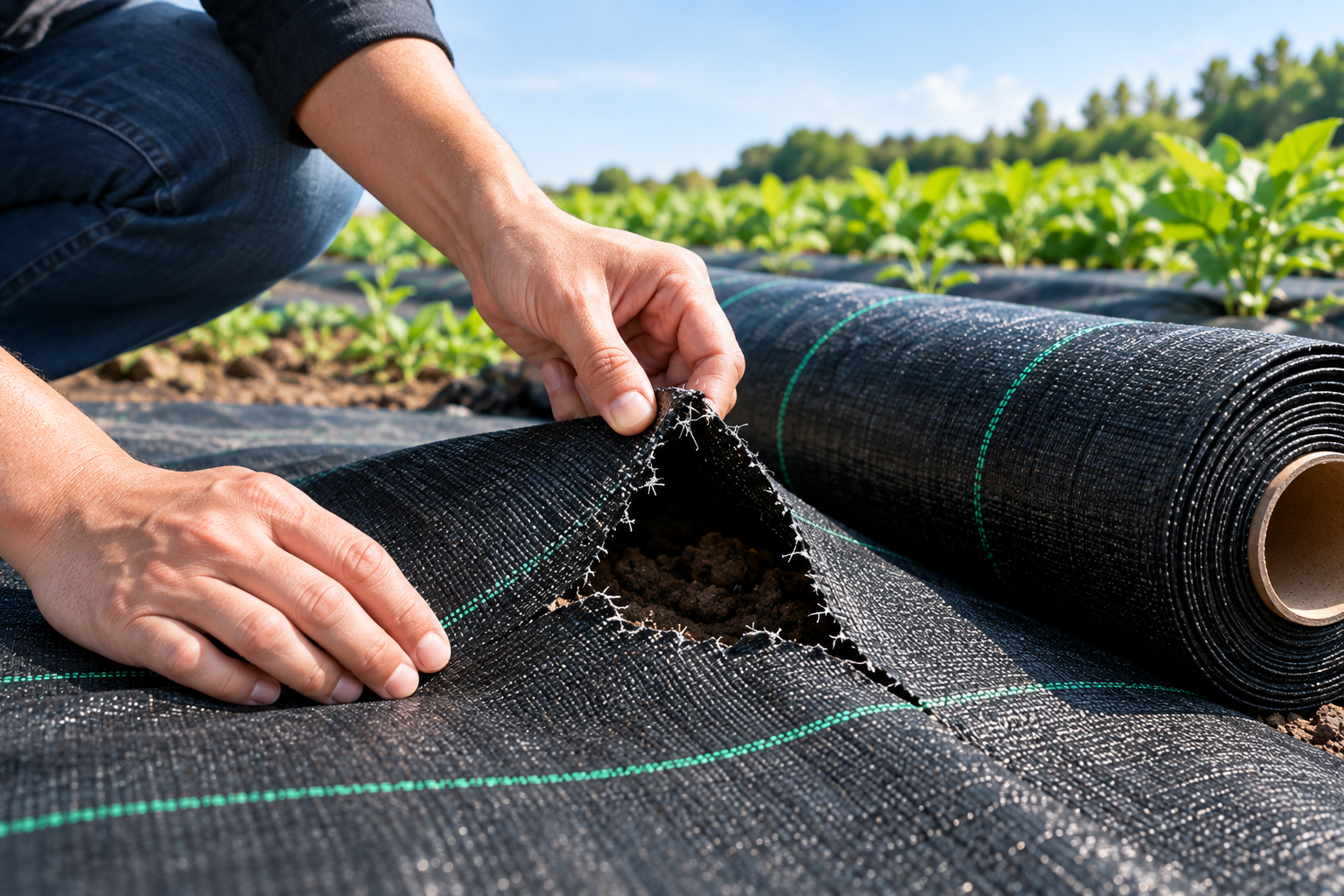
Where Thin Fabric Fails First
Anything under 70 g/m² sits in the high-risk zone. Platform-level spot checks show tear risk jumps 3x or more after 180 continuous days of sun exposure. 65g PP works fine for annual vegetables or short-cycle nursery beds. 90g+ PP/PE is the right call for orchards, tea gardens, and multi-year installs. Damage almost always starts at foot-traffic zones, folded edges, overlap seams, rolled-back borders, and anywhere the fabric contacts gravel or hard ground directly. You’ll see localized cracking, expanding holes, and fiber pulling there first. DuPont’s reliability framework tracks static/dynamic puncture, tensile strength, elongation at break, and tear resistance as the core durability metrics. They use an Energy Absorption Potential Index (elongation × tensile strength ÷ 2) to estimate mechanical damage resistance.
Three Field Tests You Can Run on a Sample
Hand-tear test. Pull a sample 3 times lengthwise, 3 times crosswise. Commercial-grade woven PP resists tearing and the tear line stays controlled. Cheap fabric splits fast along one direction at folds or thin weave points — that’s a sign of weak weave density and low yarn strength.
Water permeability test. Pour 50ml of water on the surface. Good fabric absorbs vertically within 15 seconds. 65g PP typically clears in ≤10 seconds; 90g PE runs 12–18 seconds. Too slow means pooling, odor, root suffocation. Too fast means poor moisture retention.
Sun exposure comparison. Leave one sample exposed, one shaded, for 180 days. Watch for edge whitening, brittleness, and surface chalking on the exposed piece. Sub-70g fabric fails from the edges and fold lines first.
Add a quick three-point site check after installation. Even morning condensation on the underside signals healthy moisture exchange. Topsoil moisture around 18–22% on day three is the target, with ±5% swings flagging a GSM mismatch. Water that runs sideways along fibers instead of soaking through points to poor pore structure.
The “Cheap Roll” Trap
Price per roll hides the real cost. Use 元/㎡ = GSM (kg/m²) × price per ton ÷ 1000 to compare fairly. A 100g fabric priced at ¥9,500/ton works out to roughly ¥0.95/m², or about ¥665 per mu (700m²). Common tricks buyers run into: fabric labeled 100g that tests at 90g or less; loosely woven fabric sold at low prices that lets weeds punch through at the same GSM; short-cycle fabric mislabeled for orchard or greenhouse use, leading to edge failure within a year and expensive rework. Always request GSM, width, price per ton, and roll length together before comparing quotes. Never compare price per roll alone.
Commercial-Grade vs Standard-Grade: What to Look For
|
Check Point |
Commercial-Grade |
Standard/Low-Grade |
|---|---|---|
|
Weave |
Even warp/weft, uniform pore size, clean edge cuts |
Uneven yarn thickness, irregular holes, frayed edges |
|
Feel |
Stiff, dense, springs back after folding |
Soft, thin, feels hollow |
|
Smell |
Light, stable surface color |
Strong plastic or recycled-material odor |
|
Performance data |
Tensile strength, elongation at break, tear strength, puncture resistance all documented |
Missing or vague spec sheet |
Pre-Shipment Inspection Checklist
-
Weigh a random 1m² and check it’s within 5% of the stated GSM.
-
Run the 50ml water test, record seconds, compare against the 10–18 second range.
-
Hand-tear both directions. Watch for fast splitting at folds or seams.
-
Run the sun-exposure comparison and check for embrittlement at 180 days.
-
Compare pricing by 元/㎡, not 元/卷, while cross-checking GSM, width, and roll length together.
Run these five checks before wiring a deposit, and you’ll catch the fabric that fails at the edge before it fails on your job site.
Bulk Purchasing FAQ: Four Hot Topics on MOQ, Customization, Lead Time, and Durability
Four questions come up in nearly every RFQ email. Here’s the short version.
Does MOQ apply per color or per order? Usually per color/spec, not the whole PO. Standard rolls run 50–150 units per color; custom-dyed or custom-woven PP fabric jumps to 300–500+ once you stack color plus punching pattern together — factories price the hardest variable, not each add-on separately.
How does customization stack? Color first, then width/GSM, then punching, then private labeling. Add color, pattern, and label at the same time, and the MOQ jumps to the highest tier required, not a simple sum.
What’s a realistic lead time? 25–35 days production for standard woven PP, 35–55 days for custom-dyed batches — that’s factory time only, excluding shipping. Build in 7–15 days buffer during peak season.
Woven or non-woven for repeat use? If the fabric gets reused 5+ times, woven PP wins on cost-per-use. Under 3 cycles, non-woven’s lower unit price makes more sense.
Conclusion
Matching the material type, GSM weight, and water permeability to your actual project conditions matters more than finding the cheapest bulk roll of weed barrier fabric. Then verify your supplier can back up their claims with real documentation. Get those three things right, and you’ll avoid the two most expensive mistakes in this category: premature fabric failure and a supply surprise mid-order.
The margin between a $0.05/sqm and a $0.40/sqm woven geotextile fabric almost always comes down to raw material grade and UV stabilizer quality. Those details show up in your first field season, not on your invoice.
If you’re finalizing specs for your next order, request test reports and factory audit details before you ask for a quote. At Gsunplas, we provide both as standard, along with sample kits for GSM and permeability verification. Reach out and we’ll walk you through what fits your project.


0 Comments