
You water your new garden bed, walk away feeling accomplished, and come back twenty minutes later to find a small pond forming on top of your weed membrane instead of soaking into the soil. So does heavy duty weed membrane let water through, or did you just spend good money on a fancy tarp? It depends entirely on what’s happening at the microscopic level of that fabric, and most buying guides skip right past the part that matters.
You need to understand the real mechanics of permeable weed membrane: why some non-woven fabrics let water cascade through while others practically laugh at your garden hose, what separates genuine drainage-friendly landscape fabric from the impermeable stuff masquerading as breathable, and how to spot the difference before installation day turns into a puddle-mapping exercise. No guesswork required.
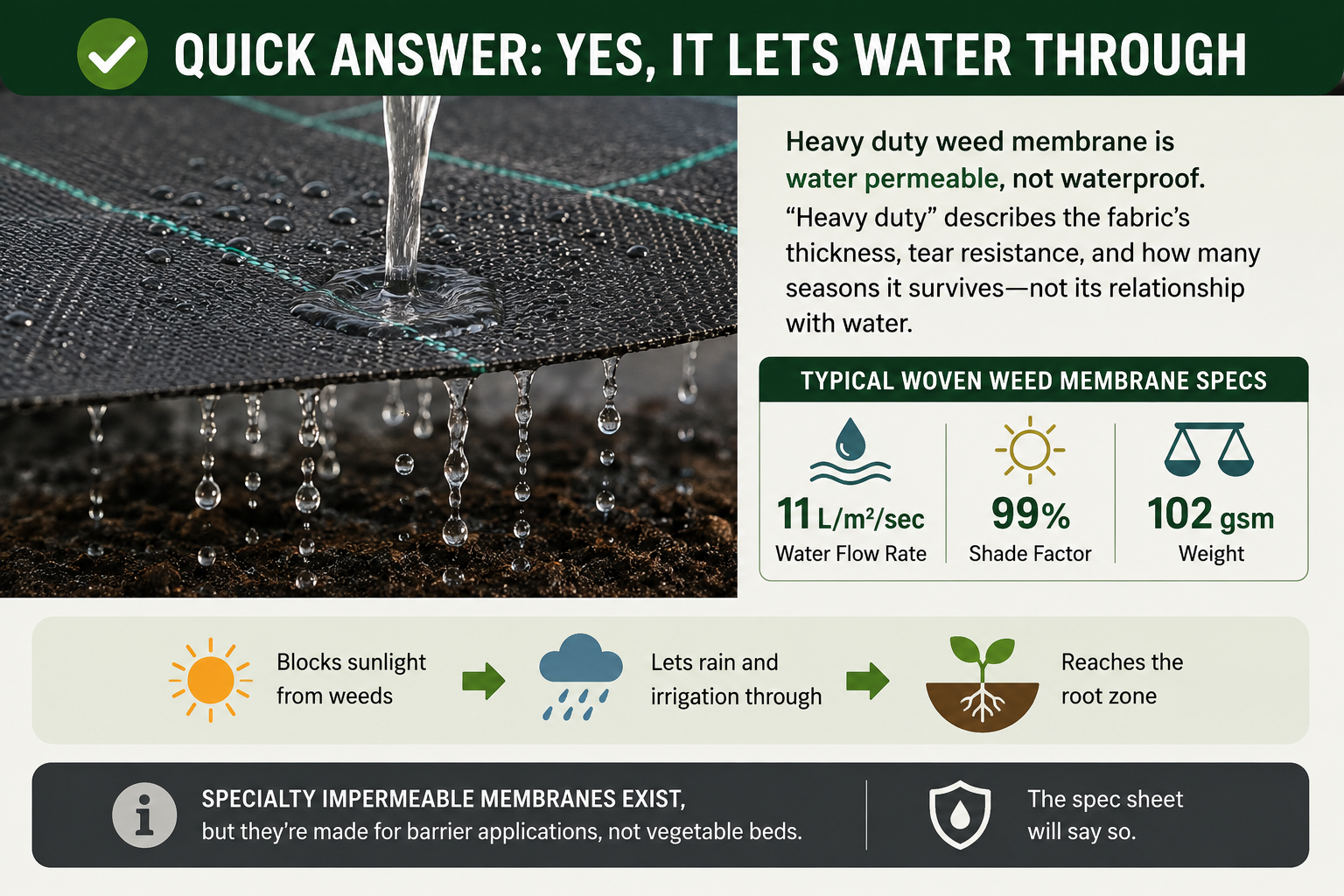
Quick Answer: Does Heavy Duty Weed Membrane Let Water Through
Short version: yes. Heavy duty weed membrane is designed to be water permeable, not waterproof. “Heavy duty” describes the fabric’s thickness, tear resistance, and how many seasons it survives your dog trampling it. Not its relationship with water.
A typical woven weed control membrane has a water flow rate of 11 L/m²/sec, a 99% shade factor, and weighs 102 gsm. That fabric blocks sunlight from weeds while letting rain and irrigation pass through to the root zone.
Specialty impermeable membranes exist, but they’re made for barrier applications, not vegetable beds. The spec sheet will say so.
How Weed Membrane Fabric Structure Affects Water Permeability
Two identical-looking rolls of black fabric can drain water at wildly different speeds, and the reason has nothing to do with color, price, or how “heavy duty” the label claims to be. It’s about pore geometry, meaning how the fibers are arranged at a scale too small to see with your eyes but very obvious to a garden hose.
Woven weed membrane is made from interlaced polypropylene tapes, like a tight basket weave. That tight grid creates small, uniform pore openings. It isn’t waterproof plastic sheeting, so water does get through, but the flow is deliberately restricted. One tested woven polypropylene membrane clocks in at 4.7 × 10⁻³ cm/s under the EN ISO 11058 standard. That’s the industry’s go-to test for landscape fabric water permeability, and it’s a much better comparison metric than gsm alone.
Non-woven weed membrane works differently. Fibers are bonded or needle-punched into a felt-like, randomized network instead of a grid. That randomness creates a more open pore structure, and open pores mean faster drainage. A typical non-woven landscape fabric is rated around 110 GPM per square foot, dramatically higher throughput than the woven equivalent.
The Thickness Myth
A lot of buyers assume thicker means less permeable. It doesn’t. A heavy-duty woven fabric at 150 g/m² can still out-drain a thinner product if its weave is looser. Permeability tracks with pore structure and porosity, not fabric weight. Non-woven products commonly range from 40 GSM up to 100–150 g/m², and weight alone tells you almost nothing about how fast water moves through.
The tradeoff is simple. Woven fabric gives you better tensile strength and more controlled flow, ideal for gravel paths and driveways. Non-woven fabric gives you better breathability and faster drainage, ideal for garden beds and mulch layers.
Breathability and permeability usually move together — fabric that lets air through tends to let water through too.
Permeable vs Impermeable Weed Membrane: Comparison Table
Numbers settle arguments better than marketing copy does. Here’s what actually happens when water hits each type of membrane, measured instead of guessed.
|
Type |
Water Flow Rate |
Best For |
Pros |
Cons |
|---|---|---|---|---|
|
Woven polypropylene |
5–12 gal/min/ft² (ASTM D4491) |
Gravel paths, driveways, perimeter zones |
High tensile strength, 98.7% light-blocking, lets air, water, and nutrients through |
Fine soil particles can clog the weave over time |
|
Non-woven polypropylene |
40–120+ gal/ft²/hr (spunbond); 120+ gal/min/ft² in high-flow benchmarks |
Mulch beds, drainage layers, uneven terrain |
Superior drainage, conforms to contours, less prone to clogging |
Lower tear strength under sharp rocks |
|
Impermeable barrier |
Zero designed flow |
Sealed isolation layers only |
Blocks moisture completely where you need that |
Traps water, causes pooling, the wrong choice for weed control |
A quick field test tells you which category you’re holding. Pour a cup of water on the fabric. Under 30 seconds means good drainage. One to two minutes is moderate. Five-plus minutes with visible runoff means you’re standing on an impermeable barrier mislabeled as a weed suppressant — a design mismatch, not a defect.
Why Water Sometimes Doesn’t Seem to Go Through (Common Misconceptions)
Puddles lie. Not maliciously — they just don’t tell you why they exist, and most people jump straight to “the fabric is broken” when three other suspects are usually standing right there.
Suspect #1: Fabric type mismatch. Woven and slit-film fabrics are engineered for stabilization. They pass water at roughly 10–15 gal/min/sq ft, while nonwoven drainage fabric moves 120+ gal/min/sq ft — an order of magnitude difference. If you installed a woven weed barrier expecting nonwoven-level ground cover fabric water flow, the problem is a spec mismatch you didn’t know you signed up for.
Suspect #2: Clogging and aging. Fine soil particles, mulch fines, sediment, and mineral deposits accumulate in the pore openings over time. Permeability can measurably drop within the first year of use. A fabric that drained fine in month one can behave like a low-grade waterproof vs permeable landscape fabric hybrid by month twelve, from particulate buildup nobody’s cleaning off.
Suspect #3: Something below the fabric, not the fabric itself. Poor soil drainage, compacted subsoil, low spots, or bad grading will pool water on the surface regardless of how breathable the weed barrier is. The membrane gets blamed for a drainage design problem it had nothing to do with.
Diagnosing Which One You’ve Got
|
Symptom |
Likely Cause |
|---|---|
|
Water beads and sits for minutes |
Surface clogging or compacted top layer |
|
Slow but steady drainage |
Normal woven fabric behavior — not a defect |
|
Water passes fabric but puddles persist below |
Subsoil compaction or a perched water table |
|
Fast, clean drainage |
Nonwoven geotextile working as intended (10⁻³–10⁻¹ m/s range) |
For reference, weight matters more than people expect. A 4 oz nonwoven fabric can hit 140 gpm/ft², while an 8 oz version of the same material class drops to around 90 gpm/ft². Denser fabric, slower flow, same “permeable” label.
Landscape fabric rarely stops drainage outright. It just doesn’t fix bad grading, and it can’t out-drain compacted soil sitting underneath it.
How to Choose the Right Weed Membrane for Water Drainage Needs
Picking the wrong weed membrane is like buying hiking boots for a job that needs flip-flops. Both are footwear. Both cover a foot. But one leaves you sweating and miserable by mile two. Match the fabric’s job description to the job you’re asking it to do.
For vegetable gardens and flower beds, go non-woven. Look for labels that say “breathable,” “water permeable,” or “drainage fleece.” Those terms are the closest thing to a warranty that your tomatoes won’t drown. Plants need frequent watering and root-zone aeration, and non-woven weed membrane is engineered for exactly that.
For gravel driveways and paths, the calculus flips. If you need load support under foot traffic or a delivery truck, choose heavy duty ground cover fabric in woven polypropylene. Check that it’s marketed for driveways or aggregate use, and that it states water permeation, not just weed suppression.
The Label Checklist That Matters
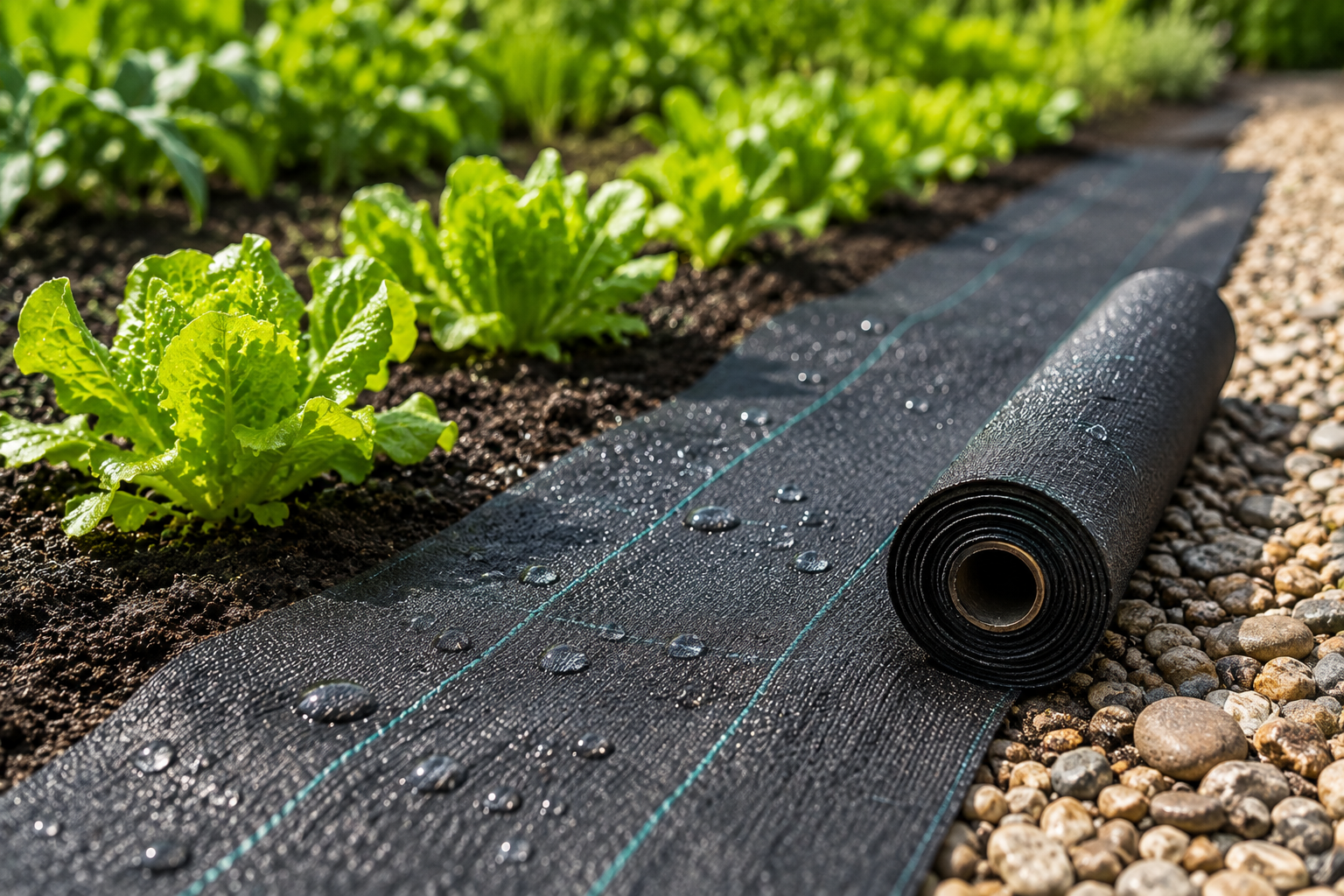
For garden beds, look for non-woven, breathable, air permeable, water permeable. For driveways and gravel, go with woven, heavy-duty, polypropylene, drainage-rated. Bonus points for specs like flow rate in L/m²/sec, weight in gsm, and UV life in years.
A solid benchmark is 102 gsm woven polypropylene rated at 11 L/m²/sec with a 7-year UV life. Anything vaguer than that on the spec sheet is a guess dressed up as a product.
Two installation details matter regardless of type. Overlap sheets by 10–30 cm on uneven ground, and round roll coverage up, never down, when measuring your area.
Installation Tips to Maximize Water Permeability Performance
Even genuinely permeable weed membrane can fail at drainage if you install it badly. How you lay it down matters just as much as the fabric.
Get the base right first. Grade your soil so it slopes toward drainage, not away from it. For weak or poorly-drained soil, bump seam overlap up to 0.6 m (2 ft) instead of the standard 0.3 m (1 ft) for general sites.
Overlap seams correctly, or create your own puddles. For light-duty garden weed membrane, 100–150 mm overlap is the minimum. If you’re using it under gravel paths or for ground stabilization, go with 300 mm. That’s also the standard for permeable paving geotextiles. Wrinkled or misaligned seams create short-circuit channels where water pools instead of soaking through, which defeats the whole point of choosing a permeable fabric.
Don’t clog the pores before you even finish installing. Clear roots, sharp gravel, and loose debris before laying the membrane. Sharp objects puncture fabric, and fine debris works into the weave. Lay it flat with no wrinkles, secure with U-pins roughly every 50 cm, and leave about 10 cm of extra material on each edge for trimming. When backfilling, sweep fill material in gradually and stop about 1/2 inch below the surface layer. Over-compacting drives fines directly into the pore structure.
Test it before you plant anything. Pour 5 gallons of water on the installed surface. Under 30 seconds means excellent drainage. 30–60 seconds is acceptable. Anything past 60 seconds means you’ve already got a clog to fix.
Weed Membrane vs Plastic Sheeting: Water Permeability Difference
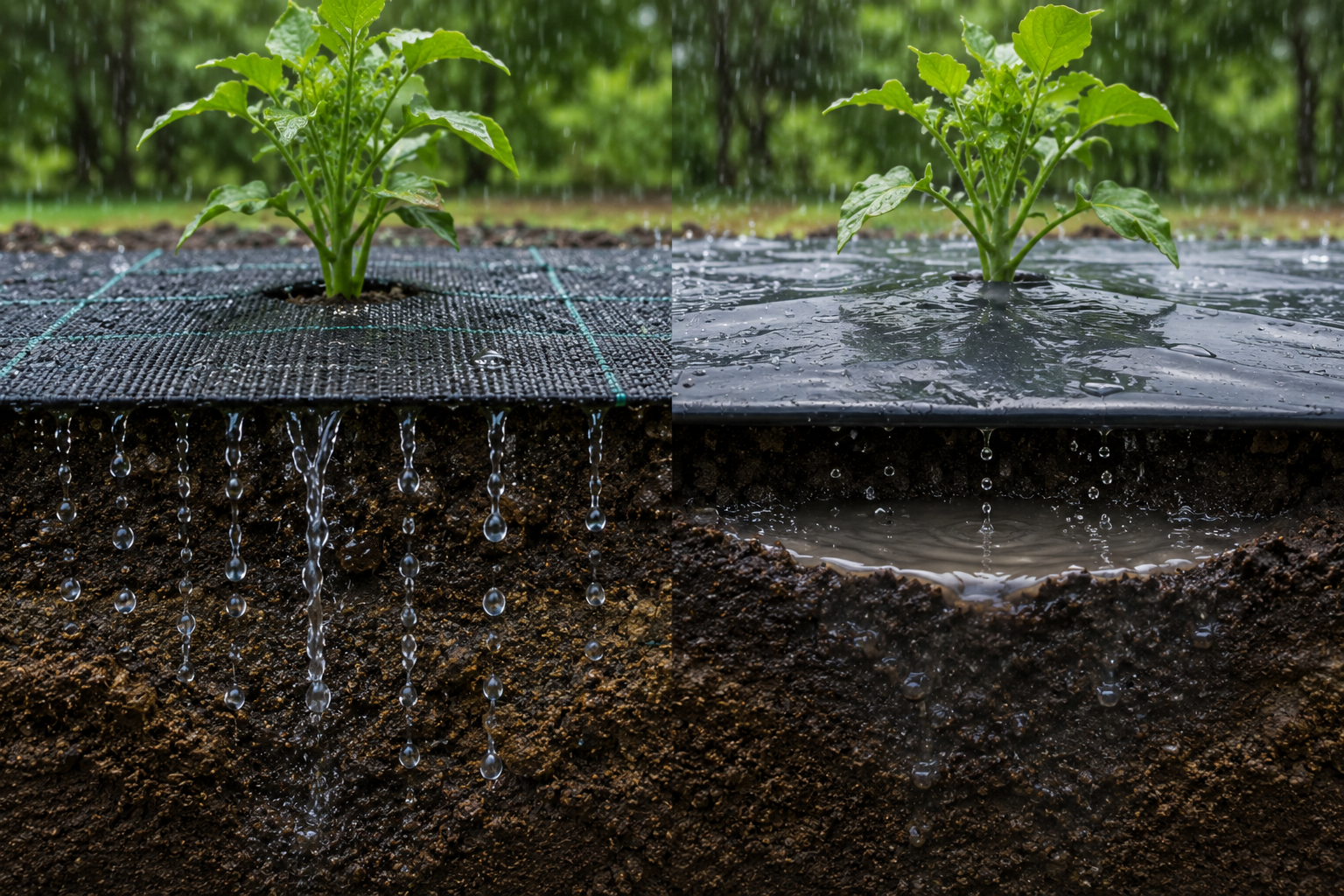
Plastic sheeting and weed membrane look like cousins from across the yard, but hydrologically they’re not even in the same family. Plastic sheeting stops water cold. Fresh polyethylene film has zero water permeability — agricultural literature describes it as impermeable unless mechanically punctured. Rain hits, runs off, and pools. Weed membrane does the opposite: some woven barrier fabrics hit 125 L/m²/sec, and U.S. forestry material puts permeable woven weed barrier infiltration at 402–491 L/m²/min. That gap is the difference between a raincoat and a screen door.
The consequence lands underground. Solid plastic cuts off water exchange between topsoil and subsoil, which over time creates anaerobic soil conditions and waterlogged roots. Weed membrane keeps that channel open, letting water and air reach the root zone while still blocking light to weeds.
For long-term beds or orchard rows, Colorado State University’s baseline spec is 3 oz/sq yd minimum, 15 mil thick, 5-year UV resistance, water permeable. Plastic sheeting still has a place — short-cycle soil warming, temporary weed knockdown — but accept the drainage tradeoff going in.
Conclusion
A heavy duty weed membrane lets water through its non-woven pores. What clogs it is usually dirt, algae, or a cheap woven knockoff. The fabric’s job is to block light and stop weeds, not water.
If your garden bed is pooling instead of draining, check your material, slope, or seams before blaming physics. A properly rated permeable weed membrane, correctly installed, lets rain do its job while keeping weeds out of yours.
Before you buy your next roll, run the water-flow math. Then browse gsunplas.com’s tested permeable weed membrane options.


0 Comments